

Washington, DC—Scientists, engineers, and contractors working at NASA rallied near the Smithsonian Air and Space Museum recently, warning that budget cuts will end U.S. leadership in space exploration, scientific discovery, and technology development. They said that the fiscal year 2025 budget previously approved by Congress last year was being systematically and illegally cut by pressure from inside and outside the Agency, specifically from the Office of Management and Budget (OMB) by its newly appointed interim leader Sean Duffy. These cuts take the form of canceled contracts that support programs, and extraordinary pressure is being placed on existing employees to take an early employment exit from the Agency.
Duffy has no science background and no experience in space exploration. He previously appeared as a cohost on Fox and Friends ‘The Bottom Line,’ and played a role on ‘The Real World’ reality TV show. He was tapped from the Department of Transportation to temporarily lead NASA after Trump dropped the planned appointment of Jared Isaacman. Isaacman is an associate of Elon Musk from SpaceX, but lost out on the position after a public squabble between Trump and Musk blew up on social media. Duffy led the FAA’s reduction in force of air traffic controllers during a period when the FAA recorded a sharp increase in air accidents, including the first airline accident in 16 years.
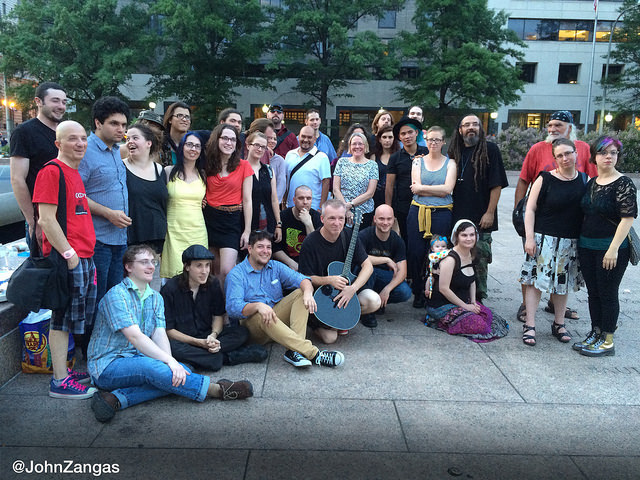
About 150 participated in the Save NASA rally at Eisenhower Park to both save and promote what NASA does to benefit the public. It was held on a symbolic date in U.S. space history, the 56th anniversary of Neil Armstrong’s first steps on the moon. It was on this date in 1969 that the U.S. safely landed the first humans on the moon in the Apollo 11 space vehicle named “The Eagle.” The landing site became widely known as “Tranquility Base” when the ship’s Captain, Neil Armstrong announced, “Tranquility base here…the Eagle has landed.” The astronauts landed The Eagle with less than 30 seconds of fuel left in its descent tanks.
The scientists and engineers at Eisenhower Park were not focusing on NASA’s glory and past achievement on that historic day 56 years ago. Perhaps in any other given year they should have been focused on it because such a momentous day of achievement deserves celebration of some kind. Instead, they were focused on what was to come of their embattled science Agency with the plans to cut 47% of its budget, which they say will devastate NASA.
NASA employees were there to tell the public that U.S. science discoveries would be lost due to many canceled projects and scientists and engineers being forced to leave the Agency. They urged the public to contact their representatives in Congress and ask them not to approve project defunding or the mass exodus of talent from NASA.
Many held hand-made signs and were observant of the constraints of their permit to remain within the boundaries of the small Eisenhower Park. A few assembled a large ‘Save NASA’ banner behind which they rallied. Some passed out stickers of the planets and provided cold water and energy bars in the searing heat. They beat drums and used noise makers to get the interest of tourists going in and out of the Air and Space Museum, the Smithsonian’s most popular museum in terms of annual visitors, though few tourists could hear them from across the street. The passing tourists remained oblivious to the coming fate of budget cuts awaiting one of the most successful agencies in terms of economic payback, in U.S. history.
A question remained unanswered by everyone at the rally: would NASA suffer the same fate as other shuttered agencies such as USAID, Consumer Financial Protection Bureau, Department of Education, and National Institutes of Health? Would NASA be shut down too, or rendered insignificant as other vital agencies have been, in the political interest of handing over public services to a few hand-picked corporations enviously eyeing their data and contracts?
NASA—Storied Accomplishments In Space
With the beginning of the Apollo missions in the early 1960s, the U.S. opened a new frontier in the quest for knowledge and understanding of the heavens. With it came the possibility that questions eluding star gazers for centuries might be uncovered. A new age dawned in which the answers could be found to the age-old questions of what is the purpose of human existence and what is mankind’s place in the heavens.
After U.S. Astronauts Neil Armstrong and Buzz Aldrin took the first walk on the moon during their Apollo 11 mission, many of the country’s youth dreamed of doing the same thing one day. Ten other astronauts followed them onto the moon on successive missions. The missions carried three astronauts; two descended to the moon while one remained aloft in the command module 47 kilometers above them. Apollos 12, 14, 15, 16 and 17 each landed two men on the moon and successfully returned them to Earth.
Apollo 13 was the only planned moon landing mission that did not reach the lunar surface because of an oxygen tank explosion in space which almost caused the unimaginable deaths of its three astronauts in space. However, they returned successfully three days later because of the extraordinary skills of engineers and scientists who understood the ship’s capabilities and worked together to learn what had happened to the stricken Apollo and to find a workable solution and safely return the astronauts home. That itself may have been the most important mission of the Apollo series because it taught some hard-learned lessons about space travel: never take any system for granted, design independent backup systems, and know the ship’s capabilities inside and out.
The Apollo missions required the development of advanced technologies using primitive machinery compared to today’s standards. There were no super computers or calculators. Slide rules were still being used for complex calculations. A complete guidance computer had to be envisioned, designed, built, and tested, and this took humans to the boundary of knowledge and beyond, as applied physics had to be merged with existing materials knowledge to create its components. Software had to be written for it and there were no such things as microprocessors or integrated circuits. Scientists and engineers had to learn to convert the computer software code into instructions the physical computer could understand using an archaic process known as rope memory. It was a technique using thin wires to generate permanent bits of data. But NASA scientists and engineers figured out how to do it.
Scientists and engineers from across the country collaborated on individual components and then teams of design engineers made sure all the components worked together. A woman-led team wrote a daisy chain code to guide the Apollo mission to the moon and back. Margaret Hamilton was the first to coin the term “software engineer.”

As the project gained publicity, many young people dreamed of becoming astronauts or becoming engineers and scientists. There would be many new missions as science and engineering progressed beyond Apollo. Skylab followed Apollo and the concept of a working laboratory in space came to fruition and paved the way for the International Space Station. Next came the Viking missions to Mars which beamed some of the first real-time images to Earth from Mars on July 20, 1976. These breakthroughs led to others and attracted a new generation of young minds with new ideas leading to space rovers on Mars in the last decades.
Then came the Voyager missions in 1977 sent to rendezvous with, photograph and explore the planets which appeared as specks in the most powerful earth-bound telescopes. Later, scientists and engineers repurposed the Voyager I and II spacecraft to explore beyond the solar system. They are the only two functional missions returning data from outside the influence of the “solar wind” and returning information about the cosmic flux, and NASA designed and built them.
As the Space Shuttle program came online in the early 1980s, NASA also began using the shuttle to launch technologically advanced platforms directly into space and ferry the large parts needed for in-space construction of the International Space Station (ISS), Then there were many Shuttle missions to ferry astronauts to the ISS once it came online in the 1990s; deliver weather and GPS satellites; deliver and position the Hubble Space Telescope into geosynchronous orbit; and complete some top-secret military projects, possibly involving “eye-in-the-sky” telescope platforms.
The benefits the U.S. has gained by investing in NASA missions has been more than three times its budget costs. A published report in Universe Space compiled figures showing that the 2023 budget of $26.4 billion dollars returned $75.6 billion dollars in economic returns even though there were private companies concurrently pursuing space exploration. There is not another Agency that creates such an economic return to the U.S. economy from tax dollars invested in public interests.
Many Ongoing Missions Will Be Discontinued
One speaker at the rally who gave his first name only as Lewis, compared the science cuts to a home invader selfishly removing the copper wire from a home everyone else shared just to cash it in for their own benefit. The metaphor resonated with the audience, particularly the engineers and scientists working on the projects facing personnel and funding cuts. He warned that the cuts are shortsighted and bound to end future U.S. discoveries.
Other countries such as China could fill this void and become the new leader in space discoveries. However, China has not typically shared its space achievements or technology advancements with other nations or even made them public like NASA has. The authorization to create NASA in 1958 stipulated that the information and science generated by public funding would be made public.
Nasa Workers Speak About The Budget Cuts
Julie Hoover, a contractor who works jointly with National Oceanographic and Atmospheric Administration (NOAA) said, “A lot of changes are being made before the budget is passed and we’re losing a lot of intelligent people from the Agency before we find out what’s going to happen to the budget.” She added that her remarks were her own and not made on behalf of NASA.
Hoover added that the project she was working on involved satellite information that tracked weather measurements. “[We] provide data to weather forecasters so they can determine what’s going to happen with the weather in time to let the public know if a disaster is imminent.”
Vi Nguyen, an employee who works on a weather satellite program said she was concerned that projects were currently being defunded illegally. She described the advanced weather satellite program as essential because the “data goes to NOAA and NOAA sees hurricanes way ahead and informs the National Weather Service to alert the public.”
Dr. Casey McGrath, an employee who works at Goddard Space Flight Center as a postdoctoral research assistant, spoke not as a representative of NASA or his company, but as an individual, saying “The senior leadership is over-complying with foundational changes to the Agency. The changes that are happening now might undermine what Congress’s intentions are if they aren’t stopped immediately. Many of us are going to lose our jobs because NASA is trying to preemptively encourage as many people as possible to leave.”
Dr. McGrath warned that NASA leadership intended to completely cut Science, Technology, Engineering, and Mathematics (STEM) recruitment. This would decimate the future of NASA and its growth as an agency.
Scientists and Astronauts Respond To NASA Cuts With Resistance Letter
Over 280 scientists, including four astronauts, signed the Voyager Declaration Letter in dissent of the ongoing NASA science cuts on Saturday.
The letter reads, in part, “We commend the NASA personnel who have courageously spoken out in defense of scientific integrity, despite clear retaliation against other scientific agencies. Their actions reflect a deep commitment to truth, accountability, and the core mission of advancing knowledge for the benefit of all. We urge NASA leadership and the current administration to work closely with NASA staff to safeguard the Agency’s mission and values. NASA must not be used as a political instrument divorced from its foundational commitment to scientific exploration, discovery, and service to humanity.”
NASA contributions to civil society have benefited everyone living in one way or another. The list of life-saving technologies is quite remarkable. NASA Spinoffs has published a diagram which illustrates some of these innovations. They have returned $14 dollars of economic benefits for every tax dollar spent.
One may recall the fable of Jack and the Golden Goose. The children’s story has a moral about how an individual’s greed can lead to his own ruin, and it applies to the taking over of NASA. The reasons why a handful of wealthy individuals are taking NASA apart may not yet be fully apparent, but if it comes to pass, it is likely to benefit a few at the expense of the nation.