
Washington DC—On October 14, community organizers and allies gathered on the National Mall to honor the life and legacy of George Floyd, whose 2020 murder by a white Minneapolis police officer sparked national protests. Police Officer Derek Chauvin knelt on Floyd’s neck for over nine minutes, ignoring Floyd’s warning that he couldn’t breathe. Floyd’s murder, like Trayvon Martin, Breonna Taylor, and more, highlighted the over-policing and police violence that Black Americans face.
Remember Your Oath (RYO) and FLARE, two organizations that maintain 24/7 protests outside Union Station, sponsored the remembrance, which occurred on what would have been Floyd’s 52nd birthday. Harriet’s Wildest Dreams, Coalition of Concerned Mothers (COCM), Freedom Futures Collective, Stop Police Terror Project DC, and Black Lives Matter D.C. partnered with them.
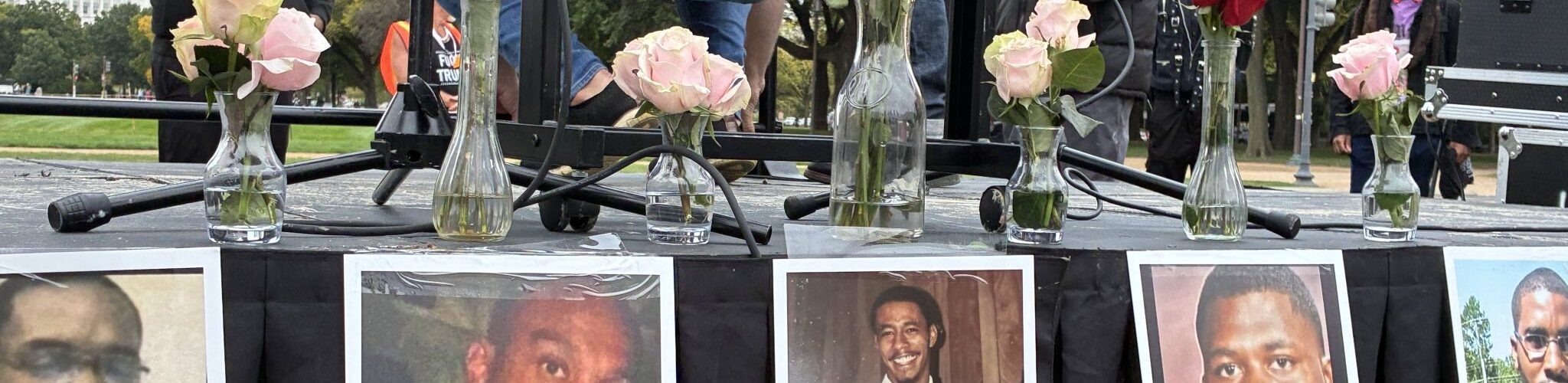
Organizers placed flowers across the platform in reverence of victims slain at the hands of police. Photos of police brutality victims from across America lined the tents and stage. One speaker observed that they represented only a fraction of the victims, and if they displayed every photo of people lost to police violence, they could cover the entire mall. The significance of the location wasn’t lost on the crowd. One woman held a sign proclaiming “I have the same dream,” referencing Martin Luther King Jr.’s famous speech at the March on Washington.
Sponsors held the event to honor Floyd’s legacy and to support those who lost loved ones to police brutality. It was especially important to recognize Floyd this year, as President Trump declared October 14th a National Day of Remembrance for Charlie Kirk, a conservative mouthpiece who shared the same birthday as Floyd.
His name only came up briefly during the event, by design. While organizers acknowledged the insult and outrage over Kirk’s Day of Remembrance, they were committed to keeping the event centered on Black voices and healing, and succeeded in doing so. “I believe that the event was incredible, it was a space that was held for the families of victims of prosperity to both tell their stories and find healing with each other. These families continue to fight for accountability for their stolen loved ones, and it’s important that we ensure their voices are heard,” Jolly Good Ginger, RYO founder and event co-emcee told D.C. Media Group. Several members of Congress initially planned to attend, but had to withdraw due to the government shutdown, then in its 14th day.
Bianca Austin, Breonna Taylor’s Aunt, offered a moment of silence for George Floyd, noting that a moment paled in comparison to the nine minutes Floyd pleaded with officers. “Nine minutes and 29 seconds,” she said. “I can get to work in nine minutes and 29 seconds.” She closed the moment of silence by breaking into a rendition of Stevie Wonder’s Happy Birthday.
In her speech, Austin encouraged the crowd to “start humanizing our impacted families.” She pointed out that even though officers were charged and imprisoned for Floyd’s death, a feat in and of itself given the justice system’s biases, right-wing news outlets and influencers still painted Floyd in any negative light they could to push their narrative. Charlie Kirk had previously called Floyd a “scumbag.” Continuing to show up and share the stories of police violence’s victims were crucial to countering the false narratives.
Austin also spoke directly to the white people in attendance to clarify often misunderstood terms. “White supremacy and white privilege, we’ve got to know the difference. White people, you are privileged…we don’t bring it up to throw it in your face, we bring it up to give you an understanding. To this day, people don’t give a fuck about us, because we’re Black.” She added, “It’s your job, if you care about us, to check that shit.”
Following Austin’s call to humanize families, a wide array of individuals spoke from the stage overlooking the Washington Monument. Members of the Coalition of Concerned Mothers, a local grassroots organization of mothers who lost children to police violence, carried signs with their loved ones’ names and pictures. Most of them never got justice for their families.
There were four images that Dorothy Elliott said were forever seared in her mind: The murder of George Floyd, the January 6 insurrection, the photos of Emmit Till, and her son, Archie III, laying “on a concrete slab with holes in his body.” PG County officers shot him 14 times while he was handcuffed. They were never indicted, and one officer killed again shortly after, Elliott said. She’s been fighting for her son for over 30 years, even attending an international conference on racism at the request of Amnesty International.
Returning to her four moments, Elliott reflected that her community could never get away with something like January 6th, yet those overwhelmingly white perpetrators had received Presidential pardons. It wasn’t too different from how law enforcement benefited from qualified immunity, a legal concept that prevents the public from filing lawsuits against government officials for violating their rights except in extreme circumstances. The qualified immunity defense makes it difficult, if not impossible, for families to seek damages in police brutality cases.
COCM Executive Director Marion Gray-Hopkins, spoke about her son, Gary, who was murdered by two Prince George’s County officers when he was only 19. With the United States Capitol building behind her, she told the crowd about the George Floyd Justice in Policing Act, a bill seeking national policing reforms which was repeatedly introduced in Congress, but did not secure the votes to become law. Despite that, “We will not stop, we will not bow down until justice comes,” Gray-Hopkins promised.
One of the last things her son wrote was a college application essay about the concept of creating a village, a community that supported and cared for each other. Gray-Hopkins closed by inviting the crowd to join that village.
Reverend Dr. Greta Willis, whose 14-year-old son Kevin Cooper, was shot and killed by officers in Willis’s own home, saw the similarities between her family and Floyd’s. In his final moments, George Floyd called out for his mother, “because he knew that’s where comfort was.” Thinking about her son, she added, “If love could have saved him, he would have lived forever.”
Investigators tested her son’s body for drugs, but not the officers who shot him. Willis highlighted the hypocrisy, “They take our children and become the judge, jury, and executioner.” She then issued a challenge to the audience, asking, “Why are you here?” Just to watch them recount painful stories? Or to do something about it?
Jolly Good Ginger, drove that challenge home. “If you’re a white person in the crowd, I need you to shut up and listen. Take it back to your white communities, your white churches.” Organizers challenged the crowd to pick a name from those displayed, commit to learning their story, and fight for justice in their case.
Nee Nee Taylor, Executive Director of Harriet’s Wildest Dream, known as D.C.’s modern-day Harriet Tubman, and fellow co-emceed, emphasized that despite the solemn occasion, joy remained critical to the fight and reminded attendees to be gentle with themselves. “We continue in this work by continuing black joy,” she said, “They cannot take away our resilience and our joy.” In that spirit, multiple performers took the stage in between speakers, encouraging attendees to dance and wave their hands. Taylor’s own nephew recited poetry.
Although most of the speakers were victims’ mothers, Jacob Blake Sr. took the microphone as a father. His son, Jacob Blake Jr. survived being shot by officers seven times. Blake Sr. looked over the crowd, turning to the performers from Message in the Music, “I’m a father, I’m a protector,” he said, “and when that happened to my son? You all became my sons.” He promised to fight for them, and declared that he wasn’t afraid—especially not of Trump.
April Goggins, an organizer with Black Lives Matter D.C., echoed that sentiment, encouraging the audience to honor Floyd by living in the fullness he was denied. “Our work isn’t just about death, it’s about life,” she said. She concurred with earlier calls to pass the George Floyd Justice in Policing Act, drug test officers, and revoke qualified immunity, but she also cautioned not to define wins by the state. After all, that same state was responsible for creating the system in the first place. Wins had to come from community success, too.
The final speaker knew all about building community alternatives. Dr. Fred Hampton Jr., Chairman of the Black Panther Party Cubs, and son of Fred Hampton, a black power activist assassinated as a part of the controversial COINTELPRO program, closed the event. He reflected on his father’s death and the differences in the climate of the 60s versus today. Despite the different energy of today’s movement, he believed the Trump administration’s actions would galvanize people to act. “People get involved in one of three ways,” he said, “Inspiration, aspiration…or desperation. And these are deathly desperate times.”