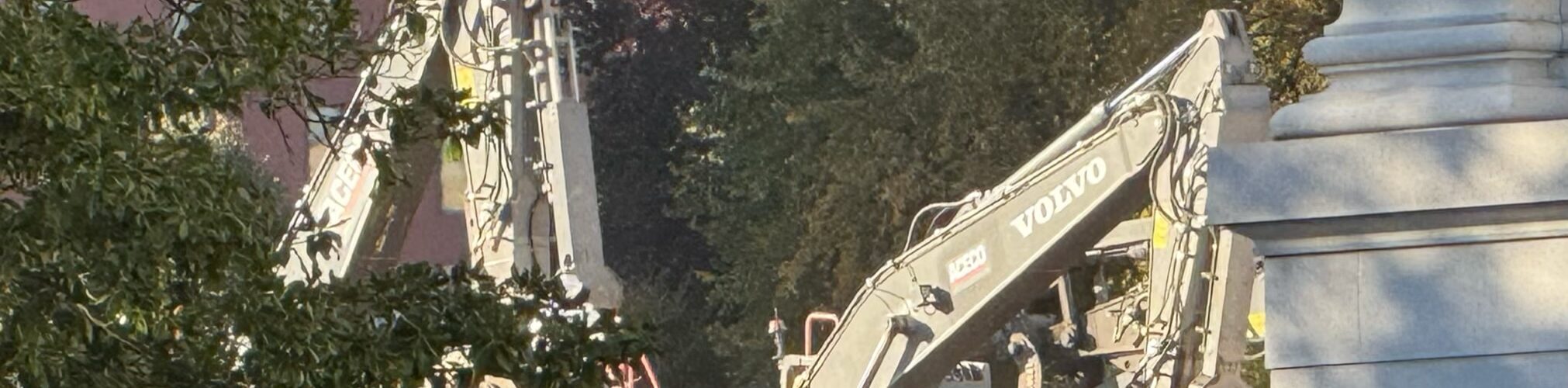

Washington DC—On Thursday afternoon onlookers stared in silent disgust as Volvo straight booms and ACECo Caterpillar excavators crushed, clawed, and removed the last remnants of the White House East Wing. Dust stirred in the cool October wind as the demolition machines operated like slow-motion mechanical monsters from a 1960’s Japanese flick, moving piles of twisted rebar with robotic indifference. As dusk fell, they stacked it for removal by large construction trucks which beeped warnings of their movements. The Jacqueline Kennedy Garden, a memorial to John F. Kennedy planted during the Lyndon B. Johnson administration and also on the east side of the White House, has been torn up and destroyed. It was a separate garden and not the Rose Garden, which had been recently torn up and paved over with concrete.
Beyond the morbid scene of destruction, a giant parade flag billowed lazily on the north lawn of the White House as if it was bored. Staff left the east wing gate silently, their heads hung low as they passed media cameras. By late Thursday afternoon, the East Wing was entirely razed. What was once the stately office of the First Lady and her staff, and its political significance as the feminine power balance of the Presidency, was rendered to an anecdotal footnote. To view it one would have to consult archives of photographs and film. The unexpected destruction was waylaid for everyone to see. And what the brave passengers of Flight 93 had fought and died to prevent on September 11, 2001, had come to pass on October 23, 2025. Terrorists did not need to lift a finger.
Initially built in 1902, renovated and expanded in 1942, and later upgraded with receiving areas for visitors and special events, the East Wing was the entrance for visitors and tours for decades. It had received dignitaries and chiefs of State, and many tourists over the decades of its existence. They would be ushered down its Colonnade Hall to visit the Red Room, The Green Room, and China Room of the main residence. From a vantage point near the East Wing gate (video) there was for the first time since 1902 a clear view of the North Portico area from the Hamilton Statue.
This latest outrage from the regime seemed to eclipse anything else it had previously done in Washington DC. The takedown of the government agencies was administrative in nature and that had its victims. It struck federal workers hard economically as well as the public in terms of federal services they provided which were largely eliminated or delayed or pending on the chopping block. Then there was the deployment of the National Guard and the ICE roundups of those pending full citizenship and migrant workers separated from family members, which in itself demonstrated the regime’s inhumanity. But the physical destruction of the East Wing was so visibly significant. It was also a metaphorical statement imbued with the White House occupiers that they could destroy any part of the government and its institutions that they wanted to because they had been given the power equal to a king from the Supreme Court.
Questions Remain About Demolition Permits And Approvals
The White House Press Secretary offered no explanation for the ruin that could reasonably silence the press. And why plans to obliterate the East Wing had been carried out despite the President’s earlier statements that no existing portion of the White House structure would be altered or destroyed were also met with more skepticism. The question remained: did they plan to raze the East Wing all along but hide it until the government shutdown captivated everyone’s attention? After all, the Press Secretary admitted the White House had consulted counsel about the demolition and assured the press the decision was legally sufficient.
The Press Secretary said the East Wing was being obliterated to make way for construction of a 90,000 square foot ballroom, which some were calling Trump’s “vanity” project by naming it after himself. The ballroom specifics had not been filled but had already mushroomed in both size and cost from a 900 person capacity at $200 million to a 1000 person capacity at $300 million. The size and scope of the project would minimize the White House itself and cover the square footage of two football fields.
Reuters photographer Jessica Koscielniak reported on Bluesky she had followed a truck carrying soil and debris from the demolition of the White House’s East Wing. The truck dropped it off at the East Potomac Golf Course in Washington DC. This in on Haines Point near the National Park Service impound lot. There is an ongoing construction buildup project nearby to raise land around the Tidal Basin due to rising tides as a result of rising oceans from the climate emergency.
There remained questions about procedures and law governing historic buildings; whether or not proper inspections had been completed to evaluate environmental impacts and hazards such as asbestos releases into the air. Structures built before 1989 were often insulated and fireproofed with asbestos. The demolition hurled yet more injury to a city growing more frustrated and angry with the continued institutional takedowns and takeovers of the government by the regime.
The demolition of the ‘People’s House’ East Wing fell in line with an authoritarian scheme because it struck another arrow straight to the heart of an institutional constant in American history and culture. The executive residence itself is an iconic structure and visited both inside by dignitaries and tourists, and by the public outside its North Portico at Lafayette Park. It had been referred unofficially as the People’s House long ago.
It paid no attention to established rules and procedures guiding modifications of national historic structures when it began demolition on Monday, October 21. There were no plans filed with the National Trust for Historic Preservation, an organization that oversees important historical structures of significance in American history. The organization formally requested the White House cease demolition in a letter it sent on Tuesday, October 22, a day after demolition began.
A published report in Veranda noted the request from the National Trust for Historic Preservation. “We respectfully urge the Administration and the National Park Service to pause demolition until plans for the proposed ballroom go through the legally required public review processes, including consultation and review by the National Capital Planning Commission and the Commission of Fine Arts, and to invite comment from the public,” National Trust President and CEO Carol Quillen wrote to the National Capital Planning Commission, the National Park Service, and the Commission of Fine Arts.
The White House, Capitol Building, and Supreme Court Buildings fall under purview of the National Park Service which has oversight of upkeep of those structures. However, there has been no publication or documentation as to how and why the plans to raze the East Wing changed from Trump’s earlier statements in regard to the ballroom “won’t interfere with the current building,” but rather, it would “be near it but not touching it,” changed to the present outcome.
Destruction And Removal More Than Brick, Stone, and Rebar
The destruction of the East Wing was more than the desecration of an iconic structure and removal its concrete and stone, wood and rebar. Intertwined with its disembodied parts was the intangible symbolic representation of the First Lady’s ascendancy to the seat of the most powerful position in world affairs. The obliteration of the East Wing was also the take down of the power of the First Lady. Why is this so?
In her book Politics of the President’s Wife, MaryAnne Borrelli wrote “The emergent bureaucracy of the [First Lady’s role] drives the spatial allocations because space in the White House is power.” It reasons that the destruction of that space is also the removal of the power of the First Lady. Relocating it to an area outside the White House is not equivalency. Under an authoritarian regime, this misogyny plays into power domination of men over women.
The power of the First Lady was formalized during President Jimmy Carter’s administration when Rosalyn Carter hired a staff of 18 and paid them salaries commensurate with others working for the President. Since then First Ladies were principally involved with campaigns to advance social justice initiatives or education.
Rosalyn Carter “focused national attention on the performing arts. She invited to the White House leading classical artists from around the world, as well as traditional American artists. She also took a strong interest in programs to aid mental health, the community, and the elderly. From 1977 to 1978, she served as the Honorary Chairperson of the President’s Commission on Mental Health,” according to the White House archives.
Nancy Regan focused on drug addiction in a “War on Drugs” campaign with a catchphrase’Just say no.’
Barbara Bush campaigned for literacy in schools, devoting her time working with the president to advancing educational opportunities for children. “As wife of the vice president, she selected the promotion of literacy as her special cause. As first lady, she worked for a more literate America, calling it the “most important issue we have.” She supported many different causes and people including the homeless, the elderly, HIV/AIDS patients, military families and school volunteers,” according to White House archives.
First Lady Michelle Obama “initiate[d] a national conversation around the health and wellbeing of [the] nation. That conversation led to Let’s Move!, an initiative launched in 2010 dedicated to helping kids and families lead healthier lives.”
First Lady Melania Trump worked on an anti-bullying “Be Best” program during Trump’s first term and planned to revive the campaign during Trump’s second term, according to a published report in People Magazine. She has spent about 2 weeks at the White House since the January 20 inauguration and has not publicly commented on the East Wing demolition.
First Lady Jill Biden, formerly a teacher and educator, worked on improving education in schools. She continued to teach while Joe Biden was president and planned to work with and advise Kamala Harris on this initiative should she have won the election in 2024.