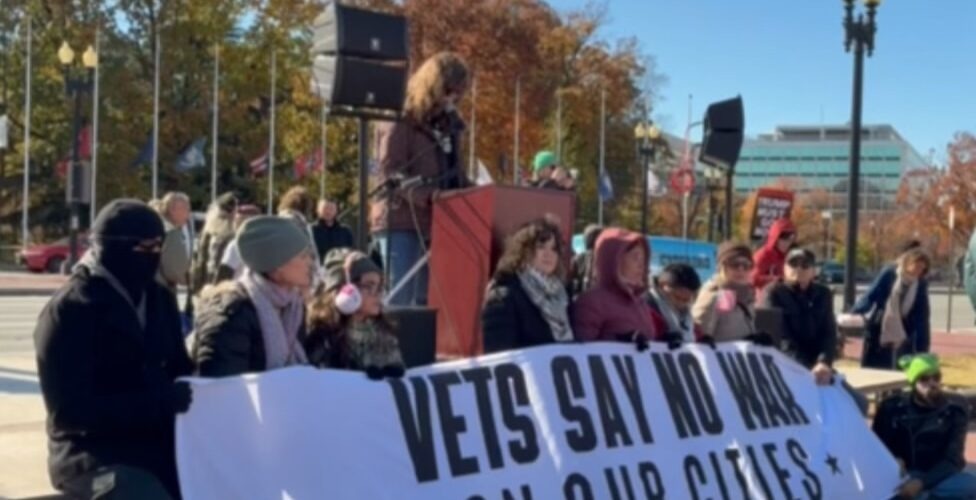

As the Department of Homeland Security wages a war at home against American citizens, immigrants legally seeking citizenship, and migrants seeking refuge, Veterans are asking the question on behalf of everyone.
Washington, D.C.— “The Marine Corps ordered the weather today.” The master of ceremonies joked, bracing against a freezing wind gust. The joke earned laughter from the crowd of veterans, along with cheers from service alumni when he added, “Should’ve had the Air Force do it.”
Jolly Good Ginger, a social media influencer, Army veteran, and founder of Remember Your Oath (RYO), continued to welcome attendees to the Veterans Day rally outside of D.C.’s Union Station. Jolly was no stranger to that location; RYO had maintained a 24/7 protest there ever since Donald Trump deployed the National Guard to D.C. The RYO tent sat mere yards from the rally stage, flying a bright purple Haudenosaunee flag. The Haudenosaunee Confederacy, also known as the Iroquois, is an alliance of six indigenous nations whose democratic ideals inspired America’s founding fathers. That’s not a DEI agenda speaking, just history.
The crowd gathered around as Jolly introduced the first speaker, Rob, from About Face. In July, veterans with About Face bypassed guardrails around the Capitol building and staged a sit-in on the building’s steps to protest Trump’s military parade. The group described itself as post-9/11 veterans who took inspiration from Vietnam Veterans Against the War to demand an end to permanent wars. Permanent wars are military conflicts that have no clear ending, like the post-9/11 forever wars in the Middle East.
Rob, aware of the sharp November chill, warmed the crowd up with another joke. “If anyone asks about the beret, I’m not Curtis Sliwa,” he said, a nod to the defeated Republican nominee in NYC’s mayoral race, before launching into his remarks. He acknowledged that on Veterans’ Day, vets could have been anywhere else. They could have lined up to watch a city parade or indulged in countless free food offers. Instead, veterans across the nation were showing up to events just like the one at Union Station, lifting their voices in opposition to Trump’s actions. To those who were at parades, he had a simple question: “Whose side are you on?”
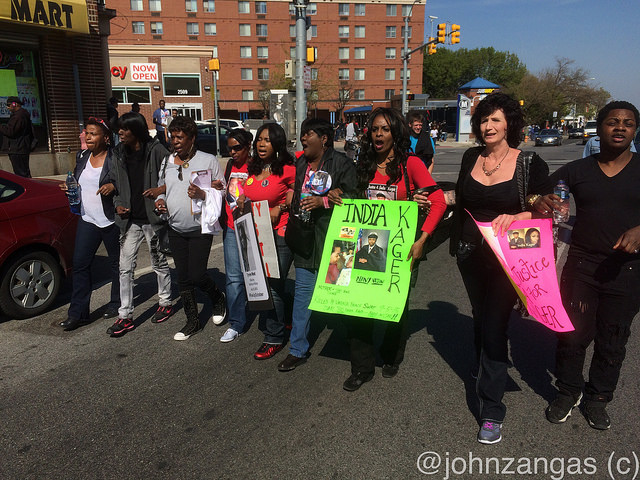
On a day when veterans were repeatedly thanked for their service, Rob confessed he wondered what service really meant. When a home across the street was raided by ICE agents, he and his neighbors joined together and stood watch, forcing ICE to leave empty-handed. That, he said, was “true service.” ICE—increasingly compared to a paramilitary force—and efforts to counter them have been a constant focus of activists, organizers, and protestors.
One rallygoer wore a jacket that read “produced by immigrants (fuck Trump).”
The National Guard deployment was also an issue of emphasis. Although no National Guard members appeared to be present, Rob previously spoke to many of them who thought their D.C. deployment was “bullshit.” The crowd cheered, echoing the sentiment. At the base of the stage, protesters held a banner reading, “vets say no war on our cities.” Rob closed by leading the crowd in a chant that summarized their feelings: “We won’t back down, we won’t retreat. Keep the military off our streets!”
Michelle Chappell, an organizer with Free D.C., continued that idea. She highlighted a viral video of National Guard troops chasing teenagers on Halloween. When did kids become the enemy…when did Americans?
She also spoke about the government shutdown. On Sunday, eight Senate Democrats had caved to Republicans, striking a deal to temporarily reopen the government. House Democrats, activist groups, and other prominent Democrats, including California Governor Gavin Newsom, criticized the rogue deal, which did little to resolve the issues that sparked the shutdown to begin with. Although the legislation hadn’t officially passed into law, once it did and the government reopened, the House of Representatives would vote on six anti-D.C. bills, Chappell shared. That included a bill to replace D.C.’s Attorney General with someone of Trump’s choosing. “What do you think will be the effect on our Black youth?” Chappell asked, referencing a community already disproportionately impacted by over-policing. “What will happen to our immigrant communities?”
Countless D.C. veterans fought for America, only to be denied the Congressional representation that their counterparts had, Chappell explained. America would never be free from the threat of fascism until D.C. enjoyed the basic rights of statehood. She summarized it in a succinct, powerful thought: “Our liberation is a precondition for the country’sliberation.”
“Free DC, and free America!” Jolly echoed, before introducing the next speaker, Air Force veteran and FLARE member, Randy. Like RYO, FLARE had a 24/7 physical presence outside of Union Station. The tent was fully permitted and operated for months until early October, when police raided it and removed the structure.
Like other speakers, the ideas of gratitude and service were on Randy’s mind. Randy, the son of a Vietnam veteran and Agent Orange victim, reflected that his father was the type of person who practiced what he preached, a legacy Randy carried on at FLARE. In many ways, his current-day advocacy is an extension of the same beliefs that led him to put on the uniform. Once, he brought his own 12-year-old son with him to the FLARE tent, where a passerby thanked Randy for what he did. “Did?” Randy’s son responded. “He never stopped.”
Randy emphasized that when they created FLARE’s name, For Liberation and Resistance Everywhere, the organizers emphasized the final word: Everywhere. He wore a keffiyeh around his neck in solidarity with Palestinians. In September, the United Nations declared that Israel committed genocide in Gaza. According to the UN, Israel also blocked humanitarian aid, leading to starvation. Multiple speakers at the rally connected Americans’ and Palestinians’ situations; both were the result of the same imperialist and capitalist greed. They warned that the tools and weapons used to fight wars overseas always made their way home.
The Global Sumud Flotilla, an international group of dozens of vessels, sailed to Gaza to break the blockade. The Flotilla ultimately failed to reach the shore, detained by Israeli forces. Climate activist Greta Thunberg was among the hundreds of sailors carrying aid to the civilians, but Jolly shared that a group of American veterans also organized a vessel. Former Army Ranger Greg Stoker explained his decision to sail with the Flotilla. In America, veterans had an overwhelming amount of social and political capital. When veterans spoke, people listened, and he wanted to use that to draw attention to issues.
Trump had previously pitched the idea of turning Gaza into a beach resort, which Stoker used to emphasize that both Gaza and the problems in America were about money, labor, and resources, and “you aren’t in the class that profits.”
During the shutdown, Trump refused to fund SNAP, food assistance for low-income families, while simultaneously pushing for a larger defense budget. Soon, Stoker warned, there won’t be any money for social programs, only for militarization. And the next war? It wouldn’t be in Venezuela. It wouldn’t be in Iran. It would be waged in America, against us.
Harrison Mann, the first Army officer to publicly resign over Gaza, also spoke. He reflected on the moral injury he dealt with daily, superiors who brushed his concerns aside. His resignation was possible because of the people around him. It was easy to tell service members to refuse unlawful orders, but for service members actually in that position, it wasn’t so simple. Mann emphasized that they needed support systems and people to help them along the way.
Following a break for Ben and Jerry’s ice cream, an apparent right-wing agitator wove through the crowd, an accomplice filming on their phone as he tried to bait attendees into a confrontation. One vet followed him around, constantly waving his large, upside-down American flag in front of the camera to obstruct the footage. When the flag is flown upside-down, it symbolizes distress.
As the break concluded, Matthew Gordon lightened the mood. “I was told I have to read things, and as an infantry Marine, I’ll do my best,” he said. He, too, reflected on what his service meant in today’s environment. He struggled to respond when people thanked him, and he decided to take a line from the Andor series. Now, when people thank him, he tells them to “make it worth it.”
It wasn’t the only pop culture reference of the day. Multiple attendees flew flags with the One Piece logo. The image has been used in worldwide protests as a symbol of freedom and resistance to oppression. On the other end of the spectrum, protestors in handmaid’s costumes huddled together in the cold. As women’s rights continually fall under attack, Margaret Atwood’s dystopian novel feels like more prophecy than fiction.
American abolitionist Fredrick Douglass famously asked, “What, to a slave, is the Fourth of July?” After hearing veterans grapple with the meaning of service to a country now floundering against fascism, perhaps we must also ask—what, to a patriot, is Veterans Day?