
Washington DC—The Venerable Monks of the Dhammacetiya arrived in Arlington Monday on their second to last day of crossing through Virginia. Their 2,300 mile “Walk for Peace” which started in Fort Worth, Texas, 107 days ago neared its final destination of Washington, DC, their journey’s end. They will host a peace gathering at the Lincoln Memorial and at the National Cathedral on Tuesday and Wednesday.
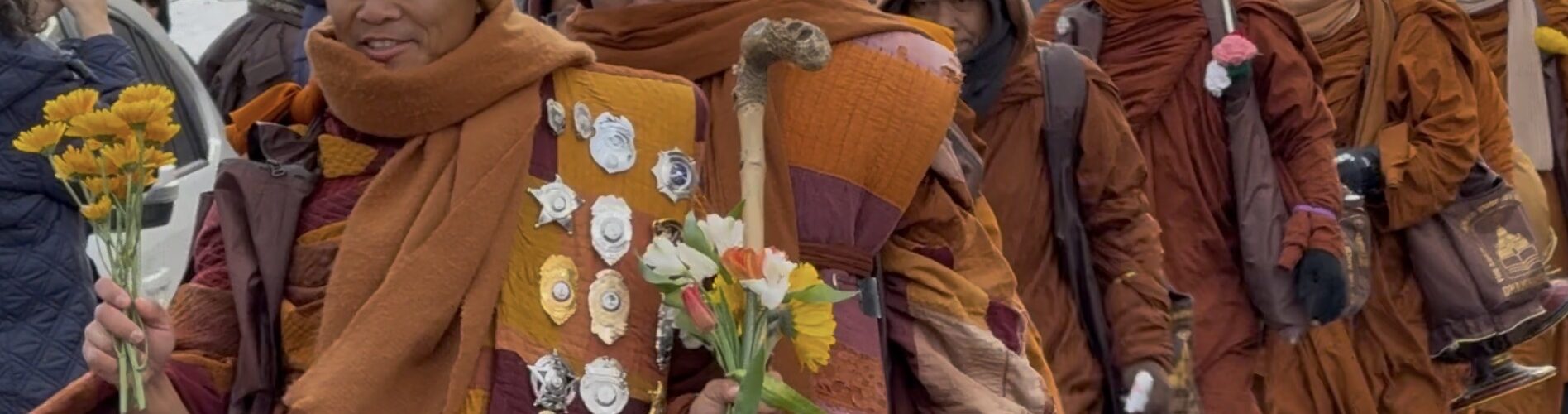
Thousands have queued along their long trek and waited many hours in bitter cold to watch the 20 monks walk past for a brief moment. Many have showed them respect by bowing or giving them flowers. Some offered other gifts such as fruit or hand warmers. Some have smiled while others have unexpectedly cried with effervescent emotion as they passed.
Their reddish faces, the product of many days of weather and sun, seemed to glow with a deep radiant hope which was reflected from the faces of those watching. Dressed in head wraps and neck carves, their deep red robes blew in the stiff cold wind as their double bagged back packs bobbled with their steps. The lead monk smiled as he accepted flowers and fruit given to him from admirers and then returned them to other admirers as a blessing.
Earlier in their journey some walked barefooted but as dual polar vortices swept south they donned boots or heavy shoes and layers of clothing. They walked an average of 20 miles a day, day after day, stopping only for meals and resting at night in churches, guesthouses, universities, and pagodas. During afternoon meals they spoke to those assembled about peace and their gratitude for the support they received. Their companion dog Aloka accompanied them through parts of the walk until a medical condition sidelined him. A white mobile home followed them with a white flag reading “Walk For Peace.”
The 20 or so monks are not requesting anything from anyone. They seem placid like a resting lake yet steadfast like a rising mountain. Their walking is a continuous statement, like a prayer without end. Their pace is fast, and their stamina is as a marathoner.
Why The Walk For Peace Matters
Their Walk For Peace began at Fort Worth, the southern most state of Texas and traversed to the nation’s capital at a time of deep anguish and upheaval throughout the country and beyond. It comes at a moment when many are worried about the future and concerned about the direction of civilization which seems to have lost its way. Many are looking to the monks for a graceful solution and here they have found a way towards that and if not, then at least through internal reconciliation.
But their message is as invisible as the breeze but as certain as a gravitational force pulling everything to its center: peace. For peace is more than an absence of conflict. It is also a state of mind. It is an intentional disposition of the spirit within and through it all beings may exist in harmony. Through their walking the monks may see every step and every crack of the pavement, every tree and body of water with each bridge they cross. They see every face and greet each voice they hear with a smile of acknowledgment and with wise contemplation. They exchange flowers with others as others give flowers to them. And as they do this they are acknowledging the significance of each human being and non-human being that meets them.
Each step they take is live-streamed so others who cannot be physically present can follow their progress. Many may take pictures too for their own benefit or perhaps to share with their followers. Others take no pictures and instead want to be completely in the moment with their contemplative thoughts of peace and hope as they pass.
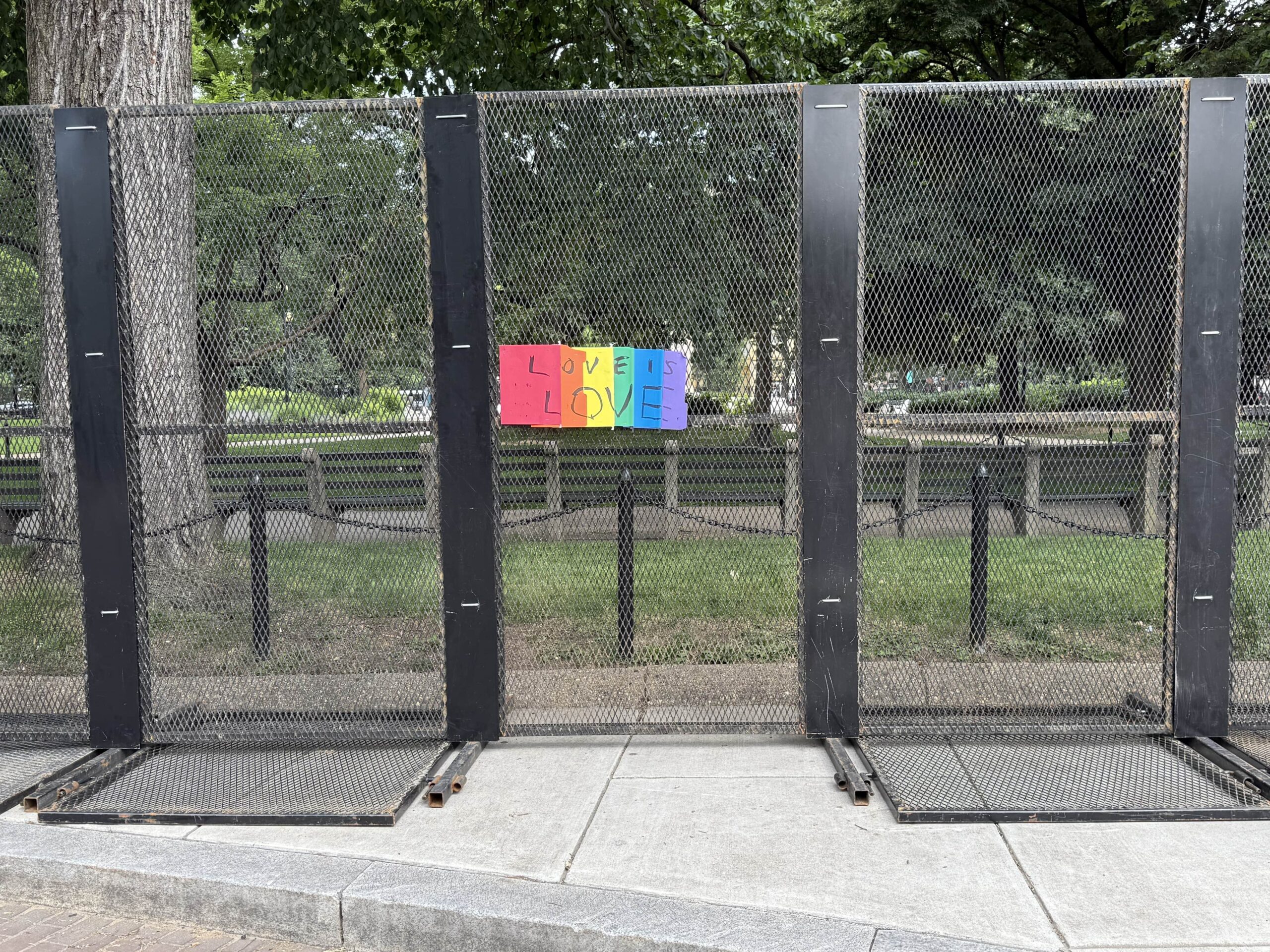
Along the way, there are children holding signs with messages of peace. One of the monks gave a friend a white carnation as he passed by her which she photographed and shared with others on her chats. Someone painted “Peace” on the ice next to the road they walked. So their peaceful expression is contagious and spreads ephemerally like prayers from the prayer wheels and like wisps of breeze across the colorful prayer flags: blue, white, red, green, and yellow.
The five colors of the prayer flags represent the five elements: blue symbolizes sky and space, white symbolizes air and wind, red symbolizes fire, green symbolizes water, and yellow symbolizes earth. Health and harmony are present when these are in balance.
In the Buddhist faith it is said millions of prayers are spread by the wind across the colors of the prayer flags. Maybe the monks are harbingers of peace and maybe not. But it is certain they instilled moments of peace, hope, and love with those who met them.
This then is their intention, to spread hope for peace through their presence.
Previous Famous Walks Have Invoked Passion For Social Change
Others have walked across the country to draw attention towards a social cause or for a benefit. In 2015, the climate marches walked from California to Washington DC over a period of six months. Their journey through many States drew attention to the climate crisis. As they passed the State line from Maryland to DC, the recited the States in the order through which they had passed. Their arrival in Washington DC in May of that year drew several hundred to Lafayette Square and spawned the local climate group Beyond Extreme Energy which still meets monthly to advocate in Congress to fund renewable energy sources.
Others have trekked across the country for various political or social purposes but usually without as much fanfare as the Monks of the Dhammacetiya have achieved in 2025-6.
In 1965, Dr. Martin Luther King, Coretta Scott King, Ralph Abernathy, John Lewis (later a U.S. Senator) walked with hundreds in a series of three 57-mile walks from Selma to Montgomery, Alabama to require local governments to grant access to the voting polls for African-Americans. An ensuing attack by police against the peaceful walkers at the Edmund Pettis Bridge was broadcast live when ABC News broke into its regular programming to cover it. The violence of police beating peaceful walkers was broadcast live into American living rooms. It resulted in the 1965 Voting Rights Act passed by Congress and signed into law by President Lyndon Johnson later that year. The walk was seen as an historic moment in the country’s history and is often repeated as a reminder of that tumultuous period in the Civil Rights movement. What began as a walk for justice helped free millions in a nation of “freedom.”
The Poor People’s Campaign in 1968 was organized by Ralph Abernathy with others of the Southern Leadership Christian Conference. Abernathy and others walked from Baltimore to Washington DC and set up a camp on the Mall in Washington DC after Martin Luther King Jr. was assassinated. The Poor People’s Campaign was organized for economic development, labor rights and reasonable wages. The walk has been repeated many times since to draw attention to the struggle of the working poor. What began as a walk for economic rights enlightened millions as to the working impoverished.
In March to April 1930, Mahatma Ghandi embarked on a 240 mile disobedience walk in opposition to a British monopoly on salt sales and high salt taxes in India. With each village he passed he spoke of the injustice of British colonialism and its unfair salt taxes on the poor. This led more to join his walk to its end at Dandi at the Arabian Sea. Once there at the salt plane, he collected salt in his hands, which was considered a crime. Other were inspired by his disobedience to act. Over 60,000 were jailed based on this immoral statute. This led to an eventual agreement between Ghandi and the British colonizers. It drew worldwide attention. And as Ghandi led more civil disobedience campaigns, he eventually gained power in the government and led his country to independence over the British. In 1947, India gained its independence. What began as a walk liberated a race and gave birth to a nation.
Dhammacetiya Monks Stir Yearning For Peace
No walk in modern U.S. history has stirred a support similar to the Monks of the Dhammacetiya Walk For Peace. None have had a spontaneous effect as seen in the last few weeks across the east coast. Thousands have been drawn to meet the monks as they have passed. Had it not been for live updates on interactive maps, spontaneous chat groups, and grassroots organizing, many would not have known to come out in support as the Monks of the Dhammacetiya passed. But they did know because there is great mobility in the commons. Mobility of the commons can move mountains and still waters.
With the response to The Walk For Peace, is a yearning for a peaceful nation. Citizens have grown weary of chaos and fear. They hope for a peaceful nation, not a nation funding occupation and bloodshed on its city streets from federal forces. They desire equality among races, not oppression based on race, religion, country of origin, or color of skin. They seek compassion from their government, harmony in their communities, and respect from leaders for others despite their differences.
The monks walked 2300 miles over 108 days without saying anything to their observers as they passed. They spoke no ill of anyone or of anything. Their message was peace, a simple prayer and a one word statement. Perhaps their prayer will be answered and it will come to pass.