- Hands Off The Arts organized a massive rally to resist the closure and demolish of the ionic Kennedy Center.
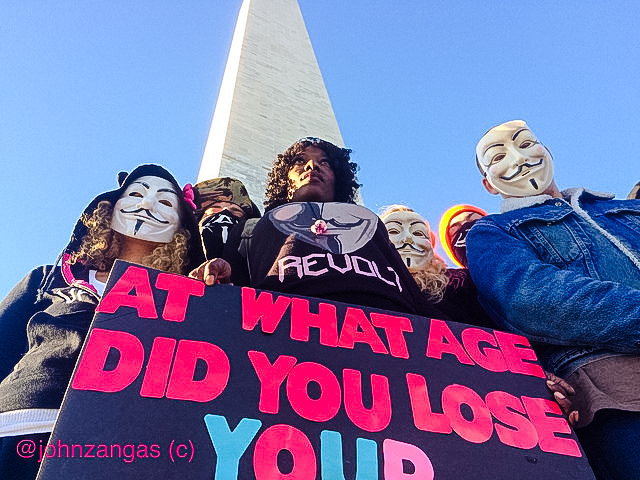
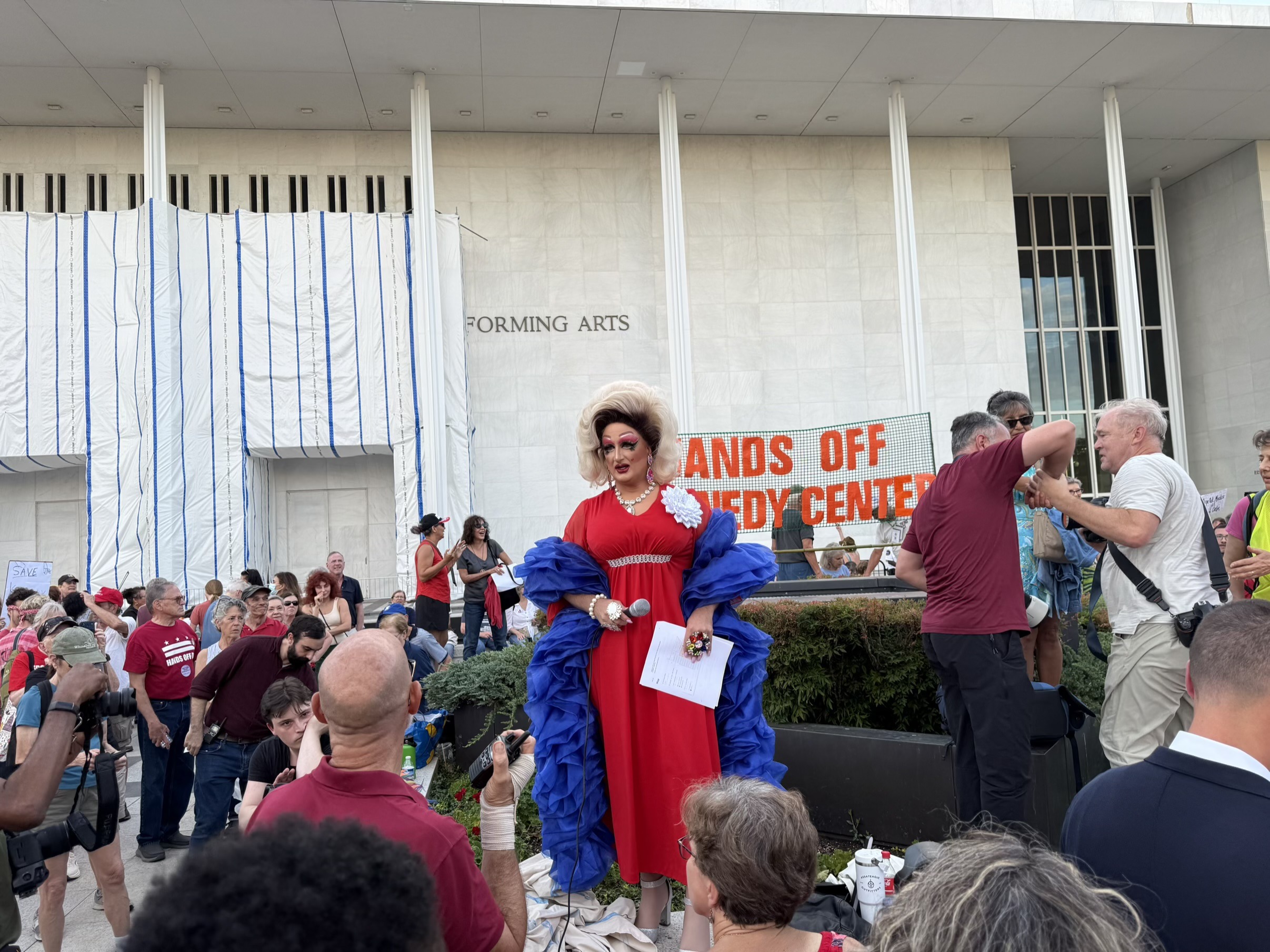
Washington, DC—The Organization ‘Hands Off the Arts,’ called on DC, Maryland and Virginia artists and supporters to stand in opposition to a plan by the White House to demolish the Iconic Kennedy Center for the Performing Arts Memorial. Several prominent speakers told of the threat that destruction posed to the freedom of expression that for over 55 years has been a central national venue for the arts community. At one point as many as 10 thousand circled the iconic white marbled landmark. They joined hands and chanted “Hands Off The Arts!”
While the numbers of concerned citizens continued to grow far past the number which had signed up online to attend, the area outside the Kennedy Center became impassable and police were forced to withdraw from the area and allow the crowd to occupy the driveway. There was no real threat to the Arts Center as the crowd only came to make a point: they intended to stand against any plan to raze the memorial.
Then the organizers did what they do best—they put on a show. The Gay Men’s Chorus of Washington DC performed ‘Make Them Hear You,’ a song about resistance and liberation from the play Ragtime. The song was previously performed at the Kennedy Center in 2019 by Brian Stokes Mitchel.
Lynda Carter, who played Wonder Woman in the TV series 1975-1979, spoke to the audience for several minutes, telling them that the arts were a vital part of living. “I see you,” she said. “I hear your hearts and you hear mine. Music and the arts is how we survive. It is how we learn. It is about vibration in the universe. It is about who we are.”
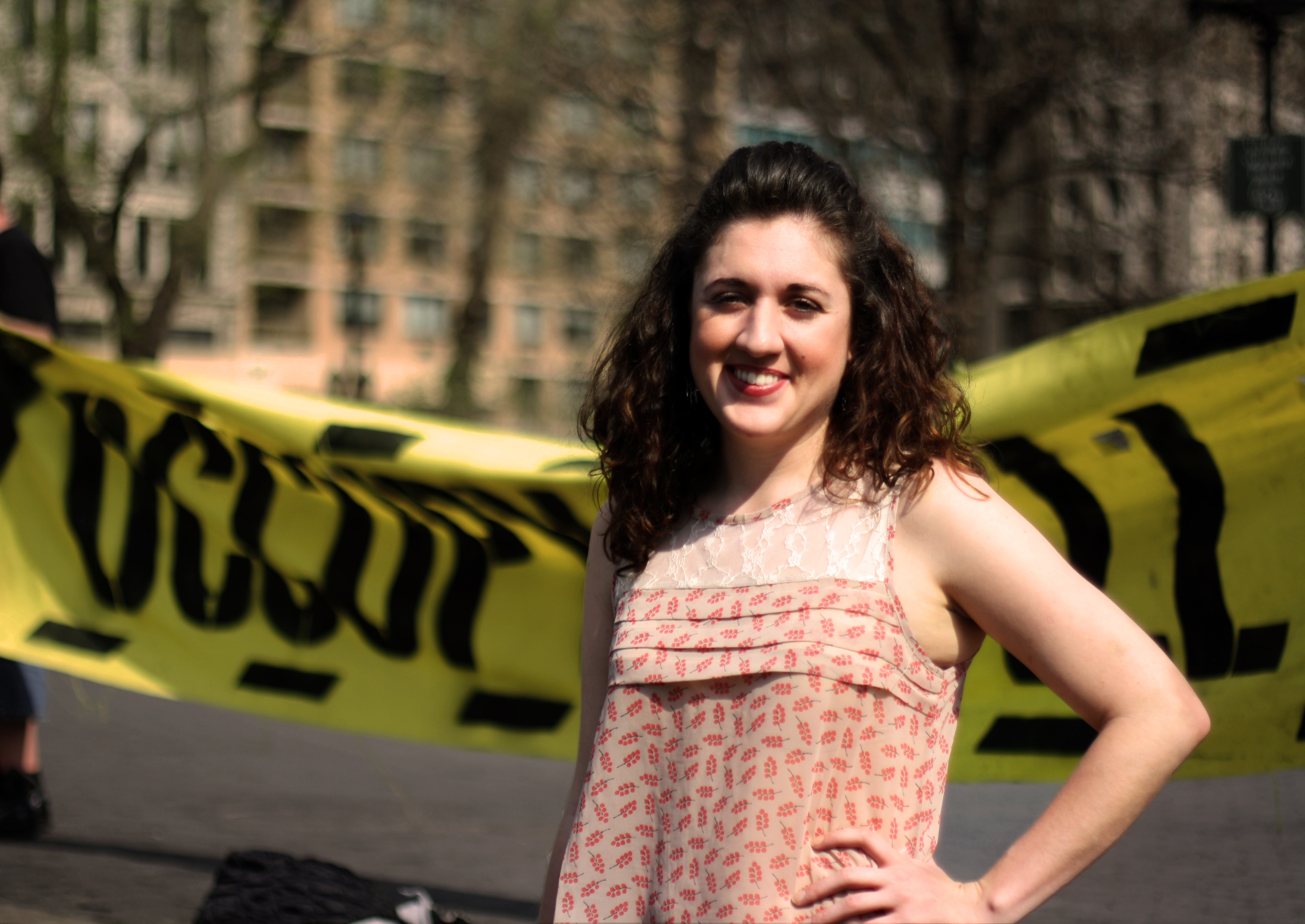
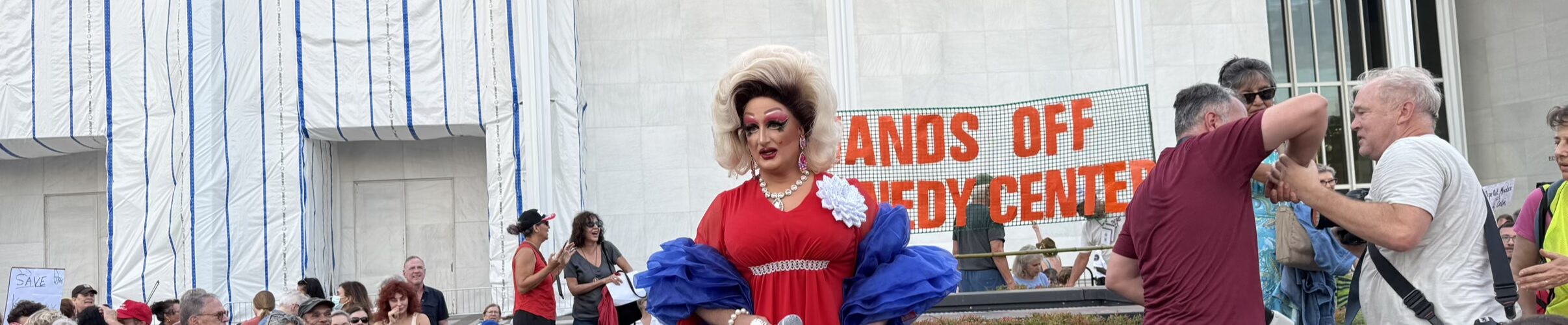
Tara Hoot, the emcee and a drag queen who previously performed at the Kennedy Center, kept the rally lighthearted though many were worried the arts venue could be in its last days. “Our message with Hands Off The Arts today is to bring hope to the American people. The people have the power to say no. Enough is enough. Donald Trump tried to slap his name on this building. It is a living memorial to an assassinated President John F. Kennedy and that’s how it needs to stay.”
Friday night’s action sent a clear signal that any attempt to demolish the memorial would be met with strong resistance at both the street level of energetic activism with mainstream enthusiasm in support, as well as from influential artists and supporters of the venerable arts institution.
It is extremely rare in Washington DC for an issue to rupture the peace which naturally occurs in the nature of performance and visual art, for it stands alone in its attraction for a diverse range of individuals, uniting them in spirit, presence, and purpose in some unexplainable way. But the White House has somehow managed to do just that. Never has the Kennedy Center drawn to its white marble facade a rising defense as was seen Friday night.
As plans of the White House intentions to begin major renovations on the memorial, were challenged in federal court, a ruling by Judge Christopher Cooper that any major renovation would require 30 days notice, triggered shock that it could come down. Throughout the arts community and beyond that shock spread and reached the activist community. Judge Cooper ruled the name change as the result of major renovations would “buck” his previous order to remove Trump’s name as well as go against existing Congressional legislation which names the arts center after John F. Kennedy.
Hands Off The Arts, has rallied at the Kennedy Center on Fridays since Donald Trump first took over the institution in February 2025. Hands Off The Arts, is an organization founded by Chris Raleigh after Donald Trump fired its Board and installed his own group of loyalists while appointing himself as the Board President. The purpose of the grassroots group, is to protect the center and reopen it to its previous state of grandeur.
After Trump took over the Board, funding began to dry up as performers canceled their shows and benefactors no longer wanted to be associated with the Trump appointed Board policies of restricting the types of venues which would be allowed. The Washington National Symphony, which had made the Kennedy Center its home for many decades, severed ties and move its operations elsewhere, a major blow to the ability of the Arts Center to draw support and donations.
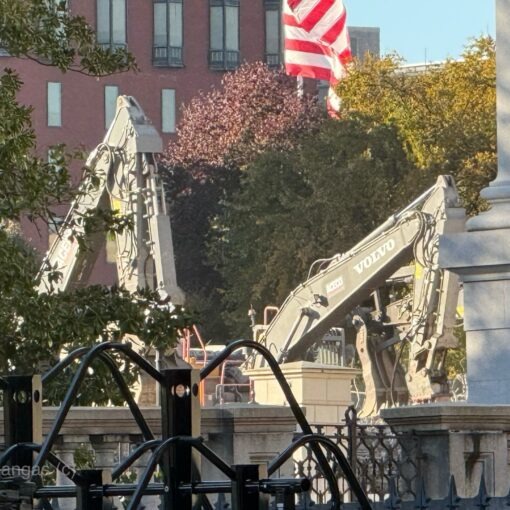
With it, more and more artists, performers, and supporters canceled performances or turned away from the Arts Center altogether. Financial support began drying up beginning a downwards cycle. The Kennedy Center was virtually out of money for operations by this month. The Trump appointed Board closed the Center lasted week and announced he would begin “renovations.” One not look much further than the East Wing of the White House or the Reflecting Pool to see what renovations actually look like in terms of what the White House means when it begins a project.
The history of the KC is a splendid tale of how interest in preserving the arts as a living national memorial inspired U.S. allies to gift portions of the construction materials to build a unique memorial, both functionally and artistically.
Italy donated over 3500 tons of white marble sheets which gave the memorial its unique outer appearance. Sweden donated 18 crystal chandeliers which remain hanging from the ceiling of the Grand Foyer. Japan donated the curtains adorning the stage of the Opera House, the second largest room in the Kennedy Center. Weaving the giant red and gold silk curtains required construction of a special hand operated loom, a one of a kind device, no longer in use. Illuminating the Opera House is a the Lobmeyer Crystal chandelier, a centerpiece with 12,000 crystals. France donated Henri Matisse tapestries which hang in the Opera House lobby. An 8-foot bronze bust of John F. Kennedy rises on a white marble pedestal in the Grand Foyer. Cast by Robert Burks, the bust weighs 3000 lbs. The Ministry of Culture of China donated murals which hang in the China Room, which abuts from the Opera House.
Built between 1964 and 1971, the Kennedy Center Memorial first opened on September 8, 1971 in a star-studded event televised nationally. Leonard Bernstein opened the Arts Venue with his production of Mass, a play involving hundreds of performers and dances. That night, hundreds of actors and performers from across the world traveled to Washington DC for the inauguration of the Kennedy Center.
The Kennedy Center was built to be a living memorial to the spirit of artistic creativity and diversity as well as a memorial to 35th President John F. Kennedy. It has since then been expanded with additional buildings near its main hall through the generous donations from many benefactors as well as from allies from around the world.