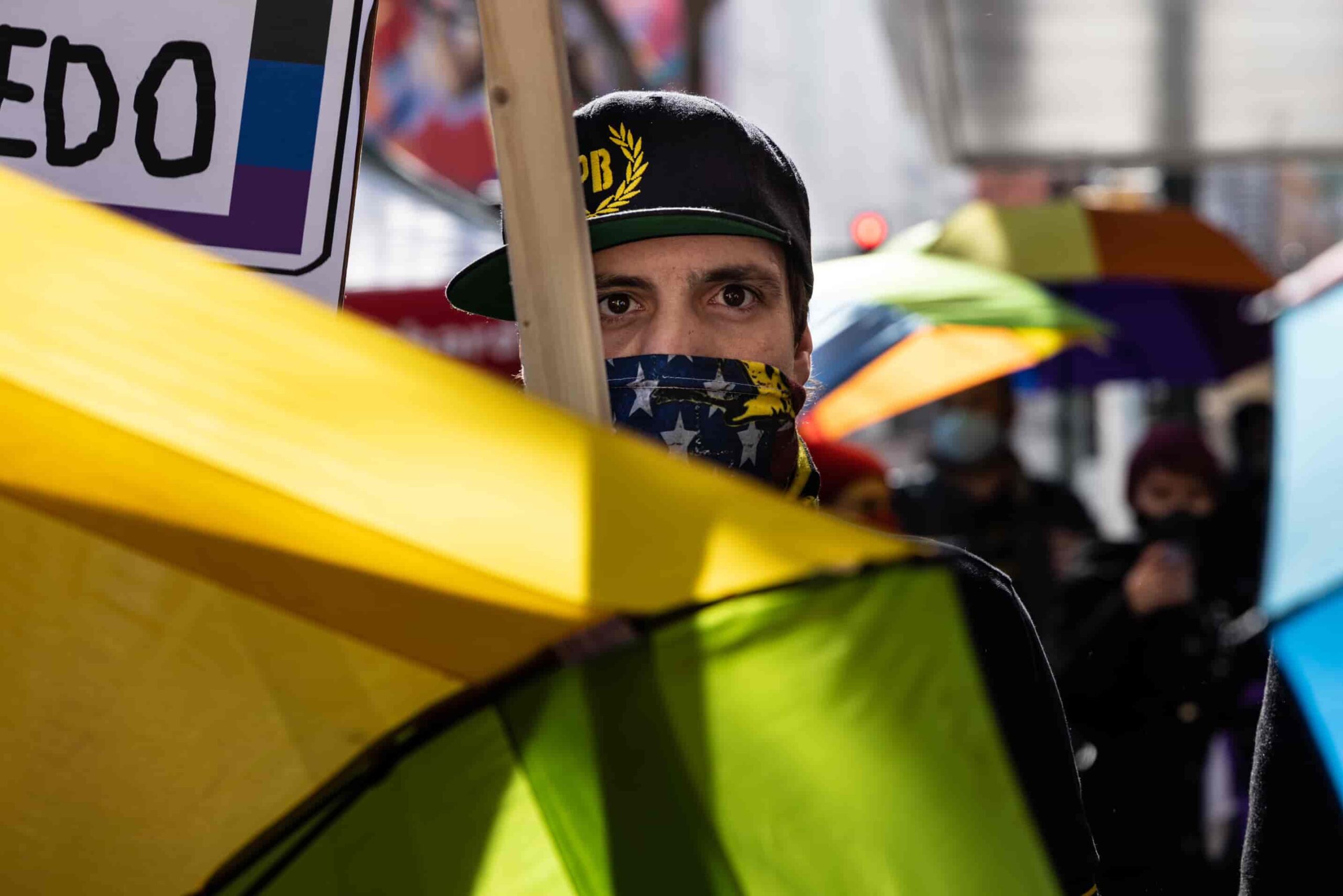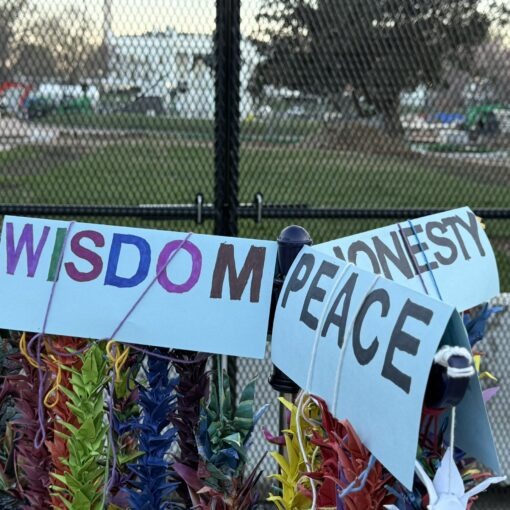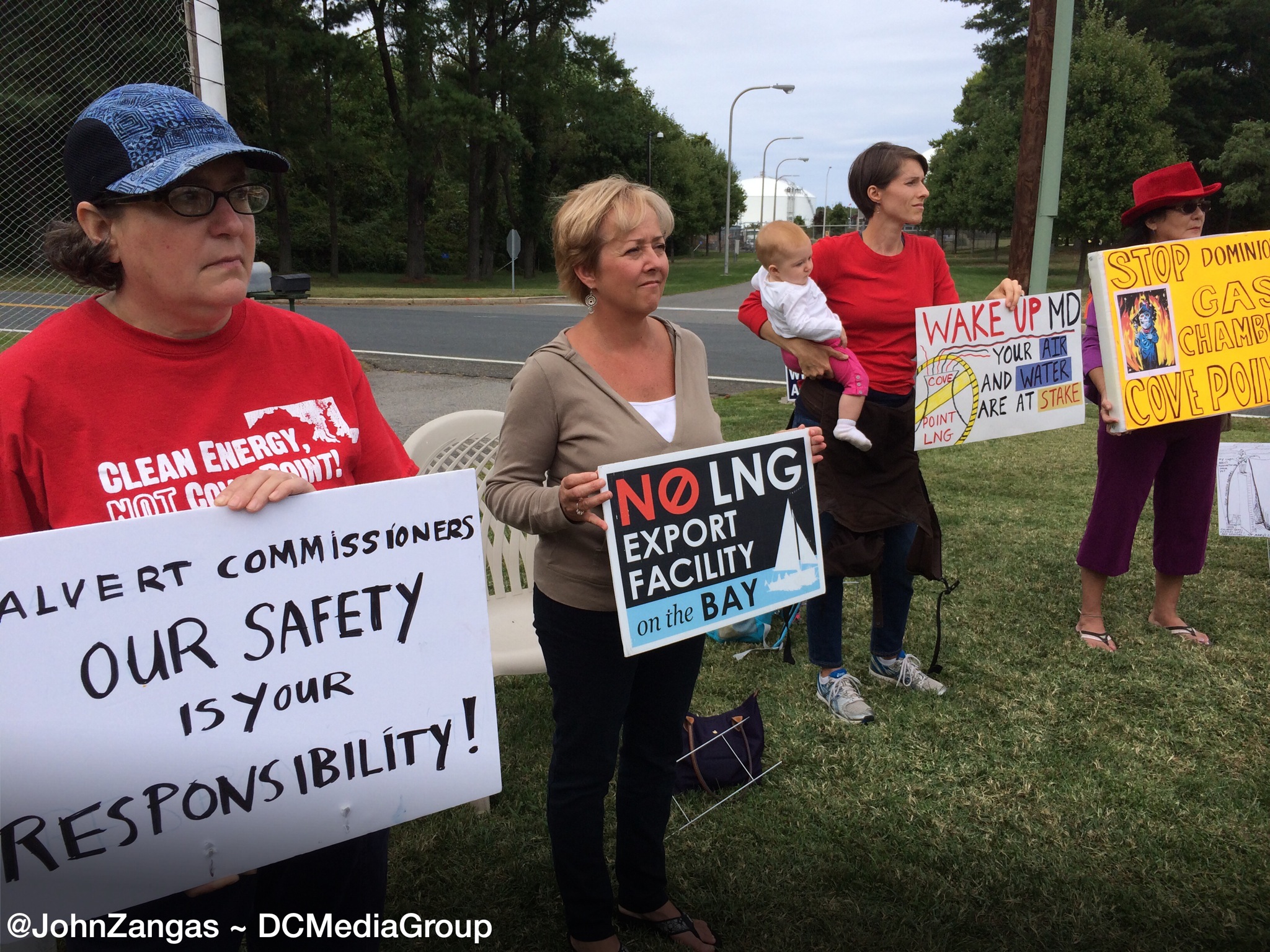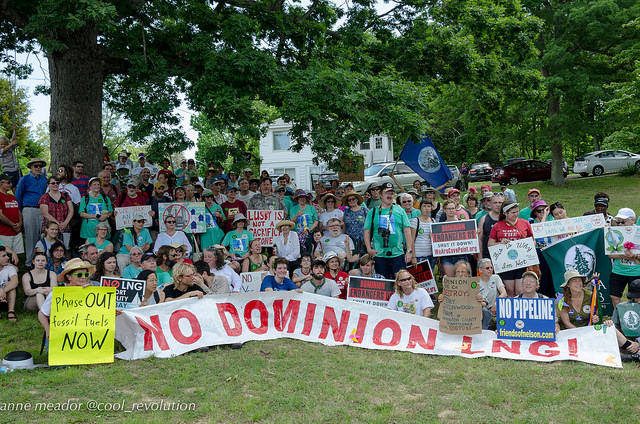

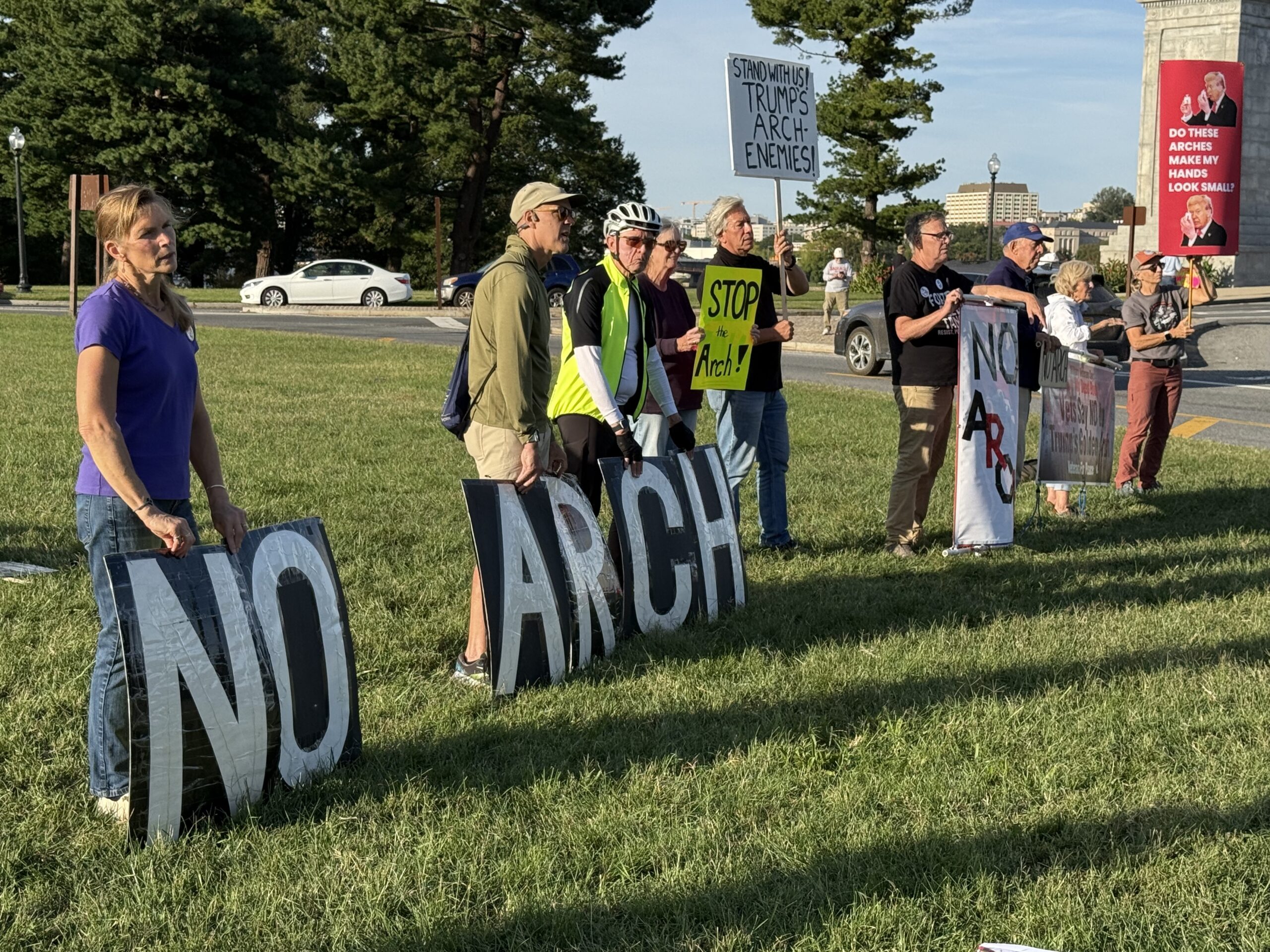
Washington DC— Its Friday afternoon and the ‘No Arch’ group has returned to Memorial Circle for their second week of afternoon protests. After a week, they’ve committed to showing up at Memorial Circle until at least the November election. They know that excavation equipment and pile drivers will soon come and they are preparing for that day.
For now they take their stand in the way they know—with signs, banners and voices. Last night a stiff cool wind blew in and though it was still a brisk day, about 20 joined the line. The wind keeps jostling the signs and everyone has to hold tight to them. A sudden gust pulls down a banner and snatches the signs from everyone’s hands nearly blowing one into traffic. Its owner dashes after it all the way to the curb.
Almost everyone on the line is elderly or nearly retired. A few are young. The line is wizened with age but hearty. But the line could use more young blood one of them comments.
Hundreds of cars pass every five minutes, many blowing their horns in support of the ‘No Arch’ protesters. The line shouts “No Arch!” as motorists honk. A few angrily yell their opposition to the protesters. The protesters laugh back at them and can’t figure out why anyone would still support the project and the man who wants built what many believe is a vanity project to himself. Perhaps he knows his time is running out and he just wants to leave a giant marker in his own memory on some of the most hallowed ground in the capital. That’s why the line laughs at those shouting angrily.
One younger woman on the line has travelled up to DC all the way from Charlottesville. She says she heard about the Arch on social media. She was upset about the Arch project being rushed and decided she had to come to oppose it. Her father served in the military and she feels the arch placement dishonors his service.
Last week a Veteran traveled from Honolulu to join the line. Some present have traveled in spirit all the way from Vietnam to oppose it. Not travel in the geographical sense, but their war experience in Southeast Asia compelled them to be there.
The Arch protest draws far fewer than the Kennedy Center ’Hands Off The Arts’ protest did one week ago. But the arch action is no less important. It draws a strong reaction from Veterans, especially those who fought in wars and survived, for they have comrades buried in Arlington National Cemetery. And for every war Veteran buried there are families with many more feelings about the proximity of the arch to their loved ones’ resting valor.
Bob Fasick, a Vietnam Era Veteran, tells everyone on the line he’s in his late 70s. He hands a newcomer an ’86 The Arch’ button, welcomes her to the line, and tells her they will be coming back every afternoon from 4 to 6. He asks her and everyone to return again on any afternoon but bring a friend. He says they have to be there. This is the way things are if they are going to beat it. They have to show up.
Present also is another Vietnam Veteran, Michael Marceau. He is holds a sign opposing the arch reading, “Vets Say: No Arch, No War, Fund VA.” The letters fill the sign completely. There’s no room for anything else. He wears a green hat with miniature replica medals he was awarded for his service in the Vietnam War. Among his medals is the Purple Heart for wounds he received when a mine went off near a tank he was mounted on. He speaks freely about his war experiences and he is matter of fact about what happened and what the war did to him. He was young then and many of his comrades did not come home.
Marceau stands by himself near Memorial Bridge where traffic is leaving Washington DC. The Lincoln Memorial stands far behind him like a silent sentry guarding the remaining ramparts of the republic. He says that he does not believe the arch is designed for Veterans as the president claims. He recalls the criticism this president constantly hurled at John McCain during his first term, challenging his patriotism. McCain was a Vietnam Veteran just like Marceau but they never met. McCain was a Navy pilot shot down over North Vietnam, seriously injured as he landed in a parachute. He was also entitled to the Purple Heart and he was a Prisoner of War in Hanoi for 5 years. McCain was in Hanoi while Marceau was in the jungle but they both had physical wounds as well as psychological struggles when they returned home.
Marceau spoke of the president, saying “He disparaged John McCain in his first term and called Veterans ‘suckers and losers’ because he did not have the courage himself to serve.” The injuries Marceau received in Vietnam disabled him permanently and qualify him to be buried at Arlington National Cemetery. Although 100% disabled, he still shows up for the arch protest. “I don’t want to spend my afterlife looking up at a cheap imitation of what is supposed to be of national significance for a man who didn’t serve.”
And though Marceau points out that defending valor is the main reason Veterans direct their outrage at the arch project, a close look at other imposing aspects of the arch reflect how wide an impact it will have on the city at this particular place.
Scope Of The The NPS Assessment
In August, the National Park Service published its arch assessment. The 108 page assessment went into great detail delineating line-of-sight impacts for every significant historical structure in visual sight of the arch and the impact of these line-of-sight views on other memorials. It briefly discusses changes to traffic patterns and how traffic patterns and biker’s paths will be altered. It references other supportive documents with links to some of them.
Traffic Patterns
What it does not do is assess how traffic will be delayed. It offers no calculation as to the average costs in time that commuters will pay over the 3 to 5 year construction timeline. This aspect of construction will have the most direct impact on the 10s of thousands of commuters along several roadways that will be impacted, including Mount Vernon Parkway, Washington Boulevard, Memorial Bridge, and traffic exiting out of Fort Meyers. Yet no significant analysis of traffic volumes or delays is provided in this assessment.
Military Platform (Not Assessed)
The arch project is one of a trend of claims from the White House along the same national security theme. Construction is necessary, it argues, to ensure “national security.” While this claim has yet to be substantiated, and there has been no study or examination of what that national security threat actually is, this is a new justification for the project and changes its purpose and scope significantly. Even if the claims to a national security threat are actually a troll and will not actually come to fruition, or if they are just a sneaky way of earning a judicial victory from the high court, should any challenges succeed in the lower courts, they must be taken seriously.
The original design therefore, has been changed from its original requirements and the National Park Assessment has already been completed as of August 2026. There is no mention in the NPS assessment of national security or of any of the military components suggested in the president’s September 20, 2026 announcement that the arch would serve as a “military complex,” supporting drones, sniper positions, or ordinance storage (bullets, bombs or grenade launchers).
Its is not at all clear what national security threats exist in the proximity of Memorial Circle, except that national security concerns at the arch were something the president first raised on September 20, 2026, just a week ago. This change in the purpose and scope of the arch has no documentation as of September 27.
There’s hundreds of thousands of tombstones on the South side in Arlington National Cemetery from where the arch will go up and on the North side, there’s the Potomac River, Memorial Bridge, and the Lincoln Memorial. One could suppose an underwater incursion could somehow come from the Chesapeake Bay upstream into the Potomac if the president’s announcement were to be taken seriously, but that’s a long stretch and requires imaginative thinking.
The arch project does have implications that can be measured and assessed. The most serious of these is aircraft safety and commuter vehicle impacts but are not meaningfully assessed.
The question of funding comes to mind. By law, national memorials are required to be funded by acts of congress. There has been no transcript or record of where funds are originating and to what entities they are being allocated and in what amounts. The contract to design and build were no bid contracts. This raises questions as to process as well.
The arch project bends and breaks the existing boundaries of regulations governing how national memorials are vetted, approved, planned, funded, and built. Congress is the authority for vetting, approving, funding and approving national memorials. This project is being rushed just like the ballroom is being rushed. Like the arch, the ballroom is being justified on national security grounds.
Air Traffic Safety
Many of the procedures involved in the arch project rushed final approvals and assessments. One step was determining the what impact the 25 storied finished arch would have on the flight paths of hundreds of commercial aircraft transiting the DC and Virginia airspace as it juts into their flight path air corridor. The Federal Aviation Administration (FAA) evaluation of the arch impact on airspace was rushed and finished in several months. It is not clear that the 8-page assessment was conducted with the thoroughness of all the risks involved in raising a super structure into an airspace where hundreds of aircraft transit daily just 2 miles from National Airport. There are no doubt risks involved with this project that will add a significant obstacle into the landing and takeoff air corridor at National Airport.
For example, how many aircraft will fly over the arch and what is the frequency of rerouted aircraft when conditions such as storms or crowded airspace affect operations. What about fog and what is its frequency? There are times when aircraft get too close to one another and have to be diverted at the last minute. Anyone who lives and works in Arlington knows this because of the sudden noise of a commercial jet flying close overhead and out of the regular flight path. How has weather impacted air travel at National Airport?
On January 13, 1982, Air Florida commercial flight 90 took off on a flight to Florida and crashed into the 14th Street Bridge. Ice formed on its wings after it was in a takeoff wueue but delayed from takeoff by a blizzard. The tragedy took 74 with it, including several in vehicles on the bridge. The accident occurred not more than a mile from Memorial Circle where the arch will be. Although that air accident resulted in changes to aircraft weather assessments and deicing procedures, and such a scenario is not likely to be repeated, it still stands as an example of the grey area of unforeseen circumstances and how they can come together to cause an aircraft accident.
Any unforeseen situation involving weather, air traffic, or equipment failure, could result in a commercial aircraft ending up where it is not expected to be. Incidentally the Air Florida accident was preceded several months by a small aircraft crash into a hangar at National Airport which was under construction. Three died in that accident.
Such unforeseen circumstances were the case of an air accident in January 2025 involving a military Blackhawk helicopter collision with an American commuter jet, killing all 67 on board both aircraft. Air accidents happen and the arch is right in the path of one of the busiest airports in the country just two miles from the end of the runway. In the January accident the National Transportation Safety Board (NTSB) investigation found that air safety issues at National Airport between numerous military operations and commercial aircraft had existed for some time. Communications between military aircraft and controllers, military helicopter lighting issues, and angles of approach contributed to this air tragedy.
The NTSB report made 52 recommendations improving air traffic safety at National Airport. Of these, 35 were made to the FAA and 13 to the Pentagon, but FAA response to 11 of these “were unacceptable” and the Pentagon has still not closed any of their recommendations almost 2 years later. On this accident alone one could conclude that air traffic at National Airport remains unsafe even without the additional drone aircraft and military platform being planned 2 miles away from it.
On September 18, 2026, just two days before the president announced the change of the arch with the requirement for a memorial and a military platform the FAA assessment approval was published. It concluded that the arch would not significantly impact air travel in the congested area.
Then on September 20, 2026 announcement from the president that the arch would serve as a “military platform” occurred 2 days after the FAA assessment had been completed, yet the nature of drone traffic and projectile limits such as height and range are not in the FAA report. Drones are pilotless and do not have the transponders that air tracking systems which the traffic controllers consult to locate where aircraft are, determine their height, and travel direction to determine what orders to relay. The existence of a drone port on the arch would lead to immeasurable uncertainty as to the safety of commercial aircraft in an emergency.
Another is the approval process of the National Historic Landmarks Commission. A public comment period was rushed and a public hearing was cancelled altogether. The public was nearly unanimous in opposition to the arch project.
But the real concern among Veterans like Fasick and Marceau is the impact it will have on the hallowed grounds of Arlington National Cemetery. This ground is visible from the circle and the arch will tower over it. It will have permanent influence on the ‘hollowed’ resting place of over 420,000 Veterans and their spouses.
In Memorial Circle signs of the initial construction preparation are everywhere. Small pink flags marking the boundaries of the arch have already been implanted into the ground. Surveying posts have also been placed in several places. One post reads “PMI Traverse” and has a long orange plastic pennant attached to it. Another survey marker is located by some pine trees which rest outside Memorial Circle. There are markings where core soil samples were taken on Thursday. The holes were drilled with excavation equipment and then filled with gravel. These actions were described as archeological assessments.
DC District Court Judge Tanya Chutkin ordered a 48-hour notice be given before any construction begins. In her ruling she did not bar archeological assessment from proceeding, but barred construction or preparatory construction. Tge Department of Justice is appealing for Judge Chutkin to remove the bar.
It is clear that preliminary stages of the arch project described in the NPS Arch Assessment are already underway. On February 29, 2026, three Vietnam Veterans filed suit against the president, the NPS and several others to stop the ‘Independence Arch’ but preparations are going forward anyway. Their argument was, in part, that the arch would interrupt the line of sight from significant historical points of interest to other monuments in Washington DC. Another of their arguments was that the president does not have the authority to build a monument because that authority rests with the congress.
So far, the Vietnam Veterans have not been present at the afternoon arch protests. If the project is going to be stopped or delayed, it will take many forms of resistance from many groups. So far, the arch project hasn’t been slowed or stopped by any of the machinations of government. If it is built, it will forever be a shadow cast over the Veterans buried at Arlington National Cemetery and a 25-storied behemoth right in the line of hundreds of commercial aircraft flying over it every day.