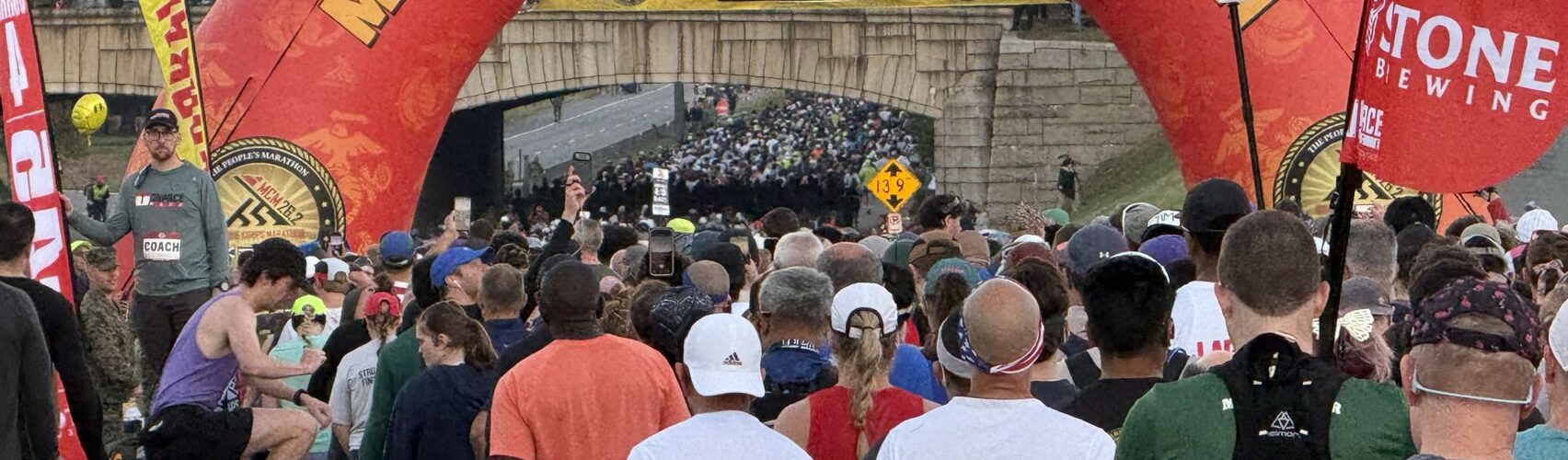
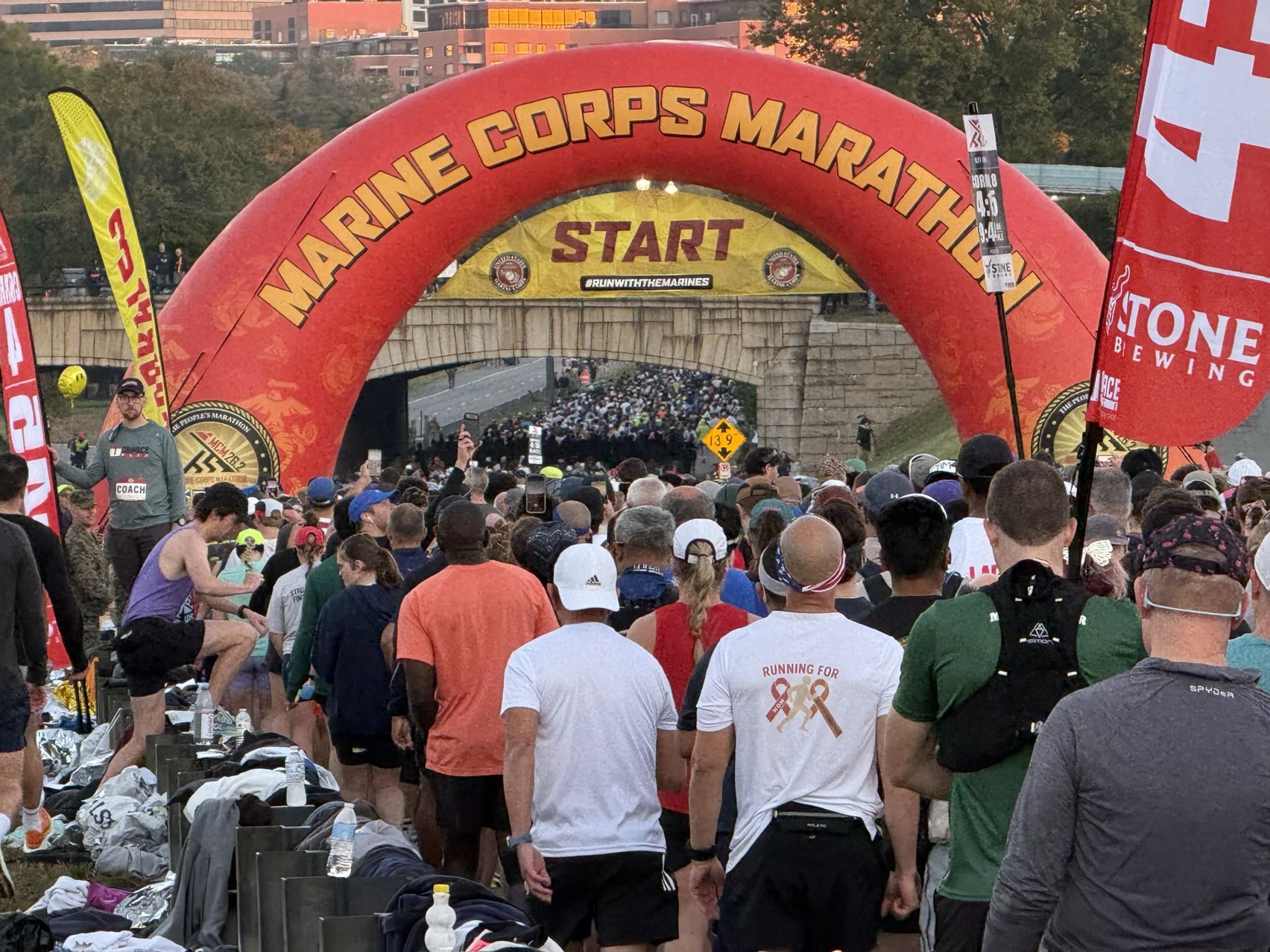
Washington DC—The Marines staged another of their well-organized marathon as they have since 1975. Nearly 30,000 runners lined up for the starting pistol as Marine Corps Commandant Eric M. Smith fired the starting pistol. The Sergeant Major of the Marine Corps, Carlos Ruiz gave the marathoners a pre-race pep-talk, urging them to stay in the race, don’t quit, and to stay hydrated.
A squadron of four Ospreys flew over and tipped their wings under a rising orange sun and then the runners were off. Many would take over 3 hours to finish with the stragglers coming in after the 5 1/2 hour mark but they were all winners in some way.
“What are you racing for? Is it for your best time? Is it for a loved one? Is it for your team? Is it for your family?” the emcee asked runners as they passed the starting line.
As the last runners passed the start, the lead runners were already passing the 10th mile mark of the 26.2 mile course. This is because it takes more than a half hour for 30,000 runners to pass under the iconic giant red starting hoops that have marked the beginning of the Marine Marathon for several decades.
But each runner would be a winner in some way, even if not by finishing first, but by finishing for some other personal reason. The least of these would be for the physical fitness they would gain from their training. Many marathoners train for months or even years, preparing themselves for the challenge and difficulty of the race, and those miles add up to improved overall health, heart and lung health, and overall stamina.
The race is not easy and takes its name from the legendary battle of Marathon in 490 BC when Greece was at war with Persia (Ancient Iran). Legend has put forth the story of the first marathon credited to a Grecian courier named Pheidippides. After he fought with his fellow hoplites, defeated the Persians, and drove them back to the sea, he then set out and ran with an olive laurel around his head from the plane of Marathon to Athens. His intention was to notify the capital city that the Greek army had defeated the Persian invaders and not to permit them to take the city if they tried to attack it. The story, which is probably a myth, is that he died after he announced the victory upon his arrival. But the battle of Marathon is credited as the birth of the Marathon race. The first official marathon was run in the 1890 Olympics held in Athens and covered about the same geographical direction that Pheidippides would have taken.
The Marines first organized the Marine Corps Marathon in 1976 to create goodwill between the Marine Corps and the community. The first race was held on November 7, 1976, three days before the Marine Corps birthday. It and drew 1,175 runners. The course layout was through Northern Virginia. Entrance fees were only $5.00 per runner and race numbers were mailed out to each runner. There were no liability or certification of health forms. The application was a one-page listing of name, age, and address. The finish line was manually timed and a numbered pop-cycle stick was given to each runner as they passed the finish line. Timers used hand held stop watches and wrote finishing times on notepads. Salt tablets and water were given out but only sporadically along the course. No computers were involved in race timing because such technology had not been developed yet. There were no frills, no gimmicks, and no sponsors. It was about as basic as a foot race could be.
The next year the course was expanded to the streets of Washington DC. It was run past the monuments that year and also became known as the race of the monuments. Later it became known as the People’s Marathon because it provided no purse money and no world class recruiting fees.
Today the race is far more advanced. Entrance applications are online and costs start at $235.00 with extra fees added for additional conveniences. For example a runner can pay a $35.00 fee to have an option to defer a race entry for the next year, or can opt to pay a $50.00 fee to pick up their runner’s bib number on the morning of the race behind the staging area. A race expo provides runners their race package and bib numbers with a patch and designer shirt, a few days before the event. Bib numbers have chips embedded and are read by scanners as the runners begin the race. Splits are taken at each 5 kilometer mark. Racers can be tracked online.
Technology has also helped design better racing shoes with lighter materials, energy efficient drinks, power bars, drink powder, and lighter clothing. There help runners replenish basic nutrients lost from the harsh distance of the marathon and the stress it causes on the muscles. Providing other conveniences such as runner clothing drop-offs and pickups is staged by United Parcel Service. This allows runners to have their change of clothing and keys or other items waiting for them at the race finish. Each runner crossing the finish is given a finisher’s medal in the shape of an Eagle-Globe-Anchor, the emblem of the Marine Corps: the Eagle stands for country, the Globe signifies world-wide service, and anchor symbolizes naval traditions.
Some things have not changed and probably should never change: The Marines still support runners at the start, during, and at the race end with plenty of high-fives and encouragement. The race ends at the Iwo Jima Monument as it has since 1976. The Marine Corps Band still plays music for runners as they pass. And the public still comes out to support the runners with signs and cheering. Finally, no matter how much one prepares, there is always a recovery period and it can take weeks for the muscles to return to their normal function.