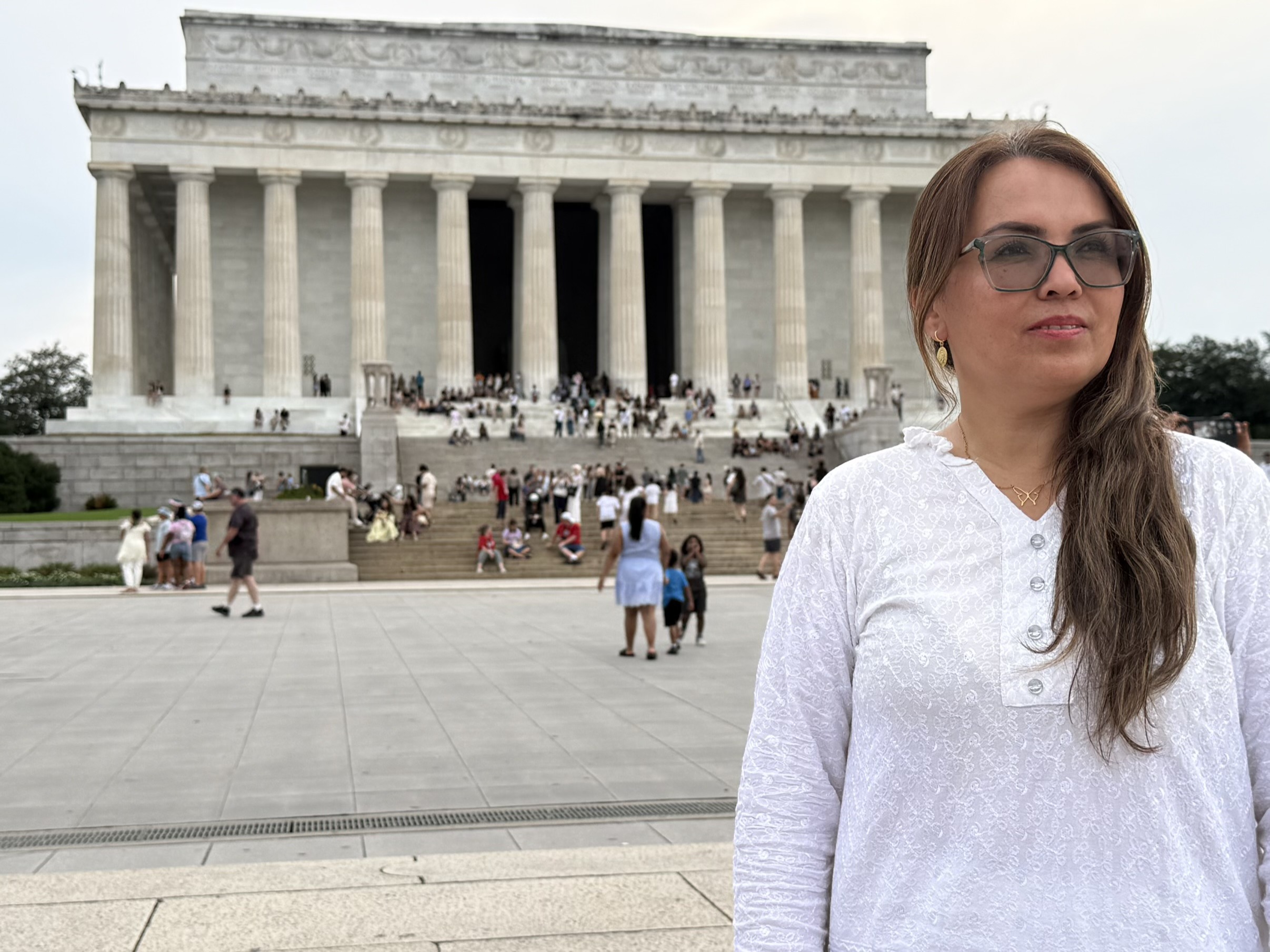
Washington DC—She smoothes the wrinkles from a white cotton dress fitted over a headless mannequin. Then she rearranges the markers evenly on the banner while reading some of the messages left by visitors about her exhibit. Next to the dress are four empty chairs with placards reading, ‘education,’ ‘work,’ and ‘freedom.’ On the last chair are copies of her autobiography, a book she first published in Iran. It was translated into English and republished this year.
On the ground nearby lay several banners telling of the oppression 8.5 million women and girls are facing in Afghanistan under Taliban rule. Theirs is a desperate plight resulting from the rise, the fall, and rise again of Taliban iron rule over Afghanistan’s 34 provinces. Taliban oppression was also the fate of Zahra Yagana, one of very few to escape the brutal cult. She has set up her exhibit at the Lincoln Memorial to tell her story and the story of millions of Afghan women suffering under gender apartheid.
Although it’s been 5 years since she escaped Kabul, Afghanistan, Zahra Yagana cherishes her improbable freedom at the steps of the Lincoln Memorial. It has been a harsh and heartbreaking journey from her forced childhood marriage at 13 to her liberation and freedom in the U.S. now several decades later. Many women did not escape the wars fought there, and the oppression they faced consumed many women, children, and families. Yagana persevered and took risks many others were afraid to take, and she found helping hands willing to take risks on her behalf. Thinking back she says she is one of the lucky ones. For everyone like her, thousands of women and girls were left behind, their voices and lives all but extinguished under a black shroud of violence and abuse.
She pauses and consider her journey and her thoughts return to Afghanistan as a young girl too young for marriage and too young to give birth yet forced into marriage and childbirth with a man she did not know, had not ever spoken to, and forced to become what was in essence his property. And though only now can she find moments to smile, the pain of her struggle shows on her face. She thinks about why she started her one-woman exhibit on the steps of the Lincoln Memorial. She again straightens the magic markers as she considers the answers to questions about her journey. Some messages are written in Arabic and Farsi. One is written in Spanish; another in Korean. International tourists seem drawn to her to hear her story.
The women in her homeland presently have no right to work, are forbidden to attend school, own property or personal items, and cannot to go outside their homes without a male escort, usually their husbands. She runs her fingers through her long brown hair as a faint smile comes across her lips; for even such an sight act is forbidden in Afghanistan and public display of the lips, face, and hair are forbidden. Basic human rights afforded to women elsewhere have been stripped from Afghan women by the Taliban. They are not allowed to speak in public, to laugh, to earn a living, or leave their homes months at a time. They are not given any consideration for the legal guardianship of their own children, if there is a family dispute between in-laws. A woman’s voice is taboo. For all the beauty of a woman must be forever kept under a black cloth called a burka once a girl reaches age 9, or as in her case, is married, whether or not she agrees with the marriage. These are not rights a woman has any say in; they have no say in what their lives will be. And along with any of the few rights women once enjoyed before the Taliban took power for the second time in 2021, more rights are being stripped as new laws are passed down by the Taliban leaders. They are made both hidden figures and figureless under the black veil of the burka both in law and in culture.
Zahra Yagana wants the world to know about what is happening to the women of Afghanistan and by speaking about her harrowing journey, she is telling the story of what Afghan women are enduring. In her book, ‘Zan, The Woman They Tried To Silence,’ she describes her experience as a child bride to a man 14 years older than she. She writes the story of her loss to all her rights, few as they were, including the right to keep her own children, his physical and psychological abuse of her body and mind. Her forced control by his family as people she did not know, where cultural mores, rituals, and ignorance overlooked and condoned his abuses that made her a nomad in her own land. But they also made her a nomadic thinker and she knew she would not yield her mind to succumb to negative thoughts over itself no matter what they did to her.
She writes of the abuse not only from her husband but also from his family, especially how his sisters, seeing him dominating her, also took part in the abuse. She wrote her autobiography not as much as a story about her although it is rich in the detail of what happened to her, she wrote it as a story of the women of Afghanistan, the Zan who dared to not be silenced.
On the bosom of the dress is written ’ZAN’ in giant black letters. It means woman in Persian, the main language of Iran. Zan has same meaning in Dari, the principal language of Afghanistan. Both countries have over 40 different languages with still more dialects and share many words, but it is this word in particular, spoken in most languages of both countries that taps a truly unrecognized and underestimated power—the power of the woman. All life flows from the woman. Life generates life through the woman, even the boys who grow up to be Taliban oppressors seem to have forgotten that.
As Iran borders Afghanistan along a jagged 972 km line and shares with Afghanistan many of the same words spoken there. But in Afghanistan, what is culturally considered a woman, is considered a child in Western countries. It is this basic conflict of culture between countries which gives rise to misogyny with human rights abuses and suffering on a massive scale still not appreciated in the Western world.
For Zahra, it is was age 13 when her parents agreed that a souter would marry her. Her mother permitted it while her father was indifferent about a 27 year old man asking them for permission to marry her. Once she moved in with his family it soon became a matter which she had no control over. As he failed to find work, he soon became a heroin addict. At that time, Afghanistan was producing more than 95% of the world’s opium. Poppies were the major crop produced with a lucrative yield on the black market and heroin in Afghanistan was both cheap and plentiful, although its use was looked down upon socially. What Afghanistan lacked in oil reserves and revenue as its neighbor Iran easily produced, it more than made up for in illicit heroin trade. Billions in opium revenue flowed through Afghanistan as if it were oil flowing straight from its fertile gardens, for the pink poppy crop easily grew in the fertile soil and the bright sunlight beaming in its fields and arid conditions for most of the year brought harvests unlike any other crop. All other crops were virtually supplanted by opium. It in turn subsumed the lives of many fallen captive to its addictive grip.
In her book she described the experiences of giving birth at too young an age and losing her first child at an early age because her body was not yet fully developed and then additionally by reason of poor birth-care. She later gave birth to two more children and was forced to take on work making bricks to support herself and her children because her husband became addicted. Soon she was able to find clerical work and learned to read and further educate herself. His jealousy of her wisdom, intelligence, and willpower often spilled into physical abuse. He took control over her earnings and used it for opium. His disposition worsened as he fell deeper into an opiate stupor.
“In our culture a girl must leave her father’s house in a white dress and leave her husband’s with a shroud.” — From the autobiography, Zan, The Woman They Tried to Silence.
One night he returned home late and set fire to her room while she and her children slept. She called out for help and the neighbors broke through the door to rescue her. She vowed never to return and sought a divorce with the local mullah, an act of ultimate indignation to his family. After many months and hearings, and hearing testimony, the mullah granted her divorce and she waived her rights to a dowery, thinking it would forever relinquish bonds between she and her husband’s family. But her in-laws tricked her into believing she could take her two children with her. At the last hearing when all the testimony had been considered and the mullah was to give his final consent to divorce, her husband’s family demanded the mullah give them custody of her children to restore their honor in the community because of the taboo of divorce. The mullah agreed to this last minute request. She was devastated. She lost her children to them. But in time she gained better work and more education and she continued to provide for their support and gave part of her earnings for their education and clothing. She eventually found out her children were not going to school and not being adequately clothed because her sister in law was taking the money for herself.
After some time as her now x-husband grew weaker and more sickly from opium, and his family suffered more misfortune as the result of his addiction. His family was unable to care for Zarah’s children and returned them to her. She rejoiced in them and provided them everything she could to help them succeed. She had by then become an independent woman and secretly sought passports to take them from Afghanistan. She only announced her intention to take them at the last minute when arrangements were made for her to safely flee because she did not want anyone to find out and stop her. She told her family at the last minute she was traveling to Iran instead of Kabul where she hid her children with allies to protect them. This was an effort to guard against her husband’s family searching and taking them as they still had a legal right to their guardianship. The mullah had the power of a magistrate and his order was the law.
“It seems that from the very beginning, a woman alone had no rights. Or perhaps no power? In this moment I cannot untangle the difference between lacking power and lacking rights.” — Zan, The Woman They Tried to Silence.
Three years passed and she became involved with advocacy and speaking publicly about women’s rights and opposing the accepted cultural norms that women should be treated less than second class citizens and even less than enslaved people. She grew restless in mind as her thoughts wandered towards a nomadic freedom and knew she could never be controlled ever again.
Zahra was both captive to her husband’s abuse and of the opium trade as well as a the ingrained culture of accepting female apartheid. She was also captive of her sister in law’s abuse as well as her mother’s abuse. She wants the world to know about these things and she wants Afghan women not to give up on themselves and to keep supporting each other so they too can find a chance to live with rights and in freedom they deserve. She believes this dark chapter of Afghanistan will not last forever. She leaves for the women of Aghanistan a message in Dari (video below).
“In the work environment and society, as in the family, the problem was not only men’s misogyny. Women themselves sometimes hurt each other, and instead of solidarity and support, they engaged in negative competition. Witnessing this treatment from women caused me even more suffering. However, I reminded myself that when women had only ever experienced oppression throughout history, it was difficult for them to be kind and supportive to each other.” — Zan, The Woman They Tried to Silence.
She does not speak much about her religion or her relationship with God but it is strong or she would not be here. She says that the Taliban do not represent Islam or any godly way of living but instead they operate like a cult. The resolve of the Afghan women runs like a wide river, silent and deep. It will outlast the Taliban but it is a guess as to when the Taliban will lose power and lose control of a society they can control only with Kalashnikovs and unyielding brutality. Their end is difficult to predict.
As the afternoon sun begins to set behind the Lincoln Memorial the shadows within grow dark on the marble man seated within. The crowds of tourists begin to wane. A group of Christian youth are drawn from the Lincoln Memorial they just visited to see the dress and ask Zahra about its significance. She speaks to them for a few moments and they listen intently about the story of a land and its people 6000 miles away. They huddle into a circle like a sports team planning an offense and then they pray together for the freedom of Afghan girls and women. A few write messages in support on the banner before them.
Zahra’s book is available online under the book title.
This story was clarified to indicate Zarah escaped from Kabul, the capital of Afghanistan.