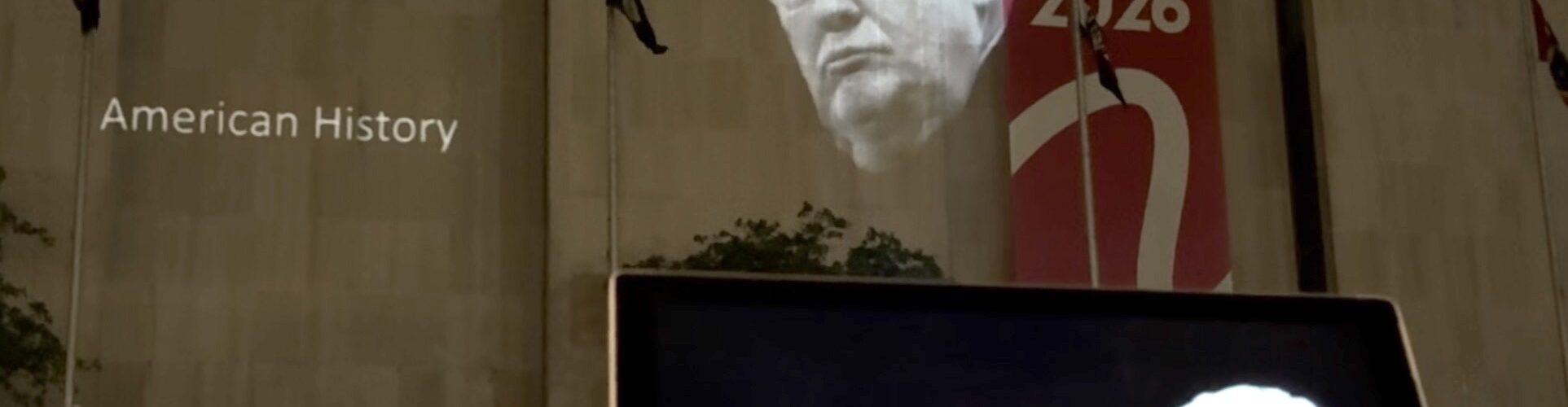
Washington DC—Third Act-DMV turned its projector lights onto the Smithsonian National Museum of American History (NMAH) late at night on Wednesday to highlight pressure to remove an history exhibit about tumultuous periods of the United States. The display focuses on the nation’s factual history of indigenous people, immigrants, enslaved people, and women, among other minority groups. It poses a basic question about the struggle of minorities to attain equality from the perspective of those adversely affected, during heightened periods of minority struggle to access the American promise. It draws the viewer into a victim’s point of view, potentially casting an unappealing shadow on how a nationalist’s point of view might conflict with what the democratic system intends.
The light projection was a simple yet poignant set of slides of a caricature of Trump overseeing a paint brush whitening out the history of immigration, the history of the struggle for equality of African-Americans, the present and ongoing fight to remove immigrants from their communities, and covering up a history outline of how minorities fought for their rights as the budding democracy began to emerge from its founders’ vision into living reality. The light show also focused for good measure its whitening paintbrush of the present: the gutting of the voting rights act, the redacting of empirical scientific climate science from websites, the gutting of information agencies such as NASA, NOAA and the department of Education, as well as a host of other issues the Trump policies have taken issue with.
As the light show beamed on the giant Smithsonian NMAH edifice, a few late night tourists stopped to take pictures but otherwise there were few observers. The series of Third Act-DMV night light actions are almost never announced as is in keeping with the strategy of the group. They video their actions and then disappear like fireflies.
On the night of the projection the National Museum of American History was closed and dark inside. While there are so many other stories much more urgently pressing down on the spirit of the country in the midst of celebrating its 250th year, the white washing of American history was no less important a moment. This is because it is yet one more example of a nation in full reversal from its role as an engine of democratic principles being replaced with authoritarian rules.
At the beginning of 2025, DC activists first began warning that the genesis of Department of Government Efficiency (Doge) and its takedown of the liberal and regulatory agencies of democratic government was a first step towards authoritarianism. As Doge was taking over and gutting or cancelling whole agencies, legacy media was in effect asleep at the teleprompter, focusing on reporting the latest Trump outrage, and not providing significant analysis as to how his policies would affect the liberal design of the government.
The legacy media was also avoiding the subject of how the Doge story paralleled the Third Reich takedown of the pre-1933 Weimar Republic of Germany and how its takedown then led to a Fascist state. It seemed the incurious U.S. Press had disavowed the ‘F’ word altogether and instead reported anything that would catch the next wave of outrage. It seemed legacy media was avoiding anything that could get it banned from the West Wing. Some were banned anyway for not staying in line with the newly unwritten anti-First Amendment rules of order and for not knowing how to stay in their new place.
But by May 2025, even some of the most non-intrusive activists in the pop-off resistance had figured out—just 5 months into the takeover—that authoritarian policies were spreading through government. They mapped out each of the policies into placards showing the steps towards fascism. It took over a year for their warnings to creep into the vernacular of mainstream discourse.
The historian Heather Cox Richardson argued last Summer that the U.S. was by definition and technically not in a fascist state. Now she is freely noting it on her podcasts and has been for some time.
During an early November press conference in the Oval Office with Trump and newly elected New York City Mayor Zohran Mamdani, a reporter asked the mayor to clarify his claims made during the NYC mayor’s race that he thought Trump’s policies were Fascist. As Mamdani began to answer in a round about way, Trump interjected and answered directly for him, saying, “That’s ok, you can just say yes.”
Fascism—Are We There Yet?
Signs of creeping fascism started with a trickle then went to a full fledged gusher as the regime began criticizing judges, slow walking their temporary restraining orders, or just flat out defying court rulings in cases involving kidnapping and removal of immigrants and green card holders vis-a-vis DHS and ICE. Recall the never ending case of Kilmar Abrego Garcia, a green card holder falsely accused of trafficking, who was kidnapped, and disappeared by ICE to El Salvador. Then there was the violations of federal worker employment rights, the takedown of consumer protections (CFPB), imposing of illegal tariffs which is the sole responsibility of the Legislature and not the prerogative of the Executive branch of government. The list goes on. The policy design was to break the liberal guardrails of the regulatory system in place for over 80 years.
One thing Fascism does it its final phases is try to rewrite history by removing every proof of past history that undermines its agenda. Of such agenda is the removal of the diversity and culture of the people that do not fit into its racist or nationalistic image. The removal of Admirals and Generals from their positions based on a preconceived notion that they were promoted based on race or gender, diversity, ethnicity and inclusion (DEI) and removing from the ranks of the Armed Forces the transgender persons, taking their access to medical transition care, are yet more signs of this. Redacting transgender and nonbinary terms from records and passports, taking their access to sports teams and to bathrooms, are further eroding norms because if this can be permitted to small segments of society, then it can be done to yet larger segments. To begin it in the first place is a step towards fascism.
Executive order 14253, titled “Restoring Truth and Sanity to American History,” instructed the National Parks Service to strip signage locating historic sites of subjects such as the climate emergency, forced relocation of indigenous communities, and signage showing the sites of enslavement, are yet more signs of this.
Theres actions were at first indicators of a regime going further and further into a fascist fest. But a series of announcements last Thursday solidified the case that this dictatorial regime was going full on public fascist.
Smithsonian Pressured To Take Down DEI History Exhibit
Such was also the case being made by Third Act DMV at the Smithsonian, where there is a plan afoot to remove historic proof of the nation’s unarguable history from public display. The exhibit in question is the history of a fledgling nation at its roots which began as an idealized concept in the thinking of its founders.
A visit to the National Museum of American History for some first hand observations revealed many plain truths. An inquiry with a volunteer at the information desk revealed they had no idea about the national news story about the exhibit under review. Most of the museum is completely straightforward from historical, sociological, and technological standpoints.
The museum maintains a first floor display of the development of the steam engine and the conversion of water motion to mechanical energy used to mill grain in the nation’s early agrarian society. A series of white, bearded old men are all credited with these scientific advances, but there is no mention of the workers in the fields and foundries who actually built these machines which propelled progress. Thomas Edison is heralded as the inventor of the lightbulb and the father of the electric grid, of which he had no idea how it would change the country and the world.
There’s a display about the value of money and a comparison of currencies. The John Bull steam locomotive sits on a segment of tracks as it has for decades. Other exhibits show an early bike, Maya Angelo’s electric typewriter from 1980, an early iPod from 2002, Julia Child’s kitchen, and many other artifacts showcasing innovations, inventions, and entrepreneurial spirit.
There’s a temperature controlled dark room where the original Stars and Stripes flag rests in protected custody. It is a flag of a nation once at war with Great Britain, the giant 40’ x 50’ flag which flew over Fort McHenry, the one that inspired Francis Scott Key to write the Star Spangled Banner. There’s nothing close to controversy about this artifact, although one could suppose the flag was raised over land taken from Indigenous people but that is another issue.
The staff guides at Smithsonian NMAH did not know where or what the controversial exhibit was but it wasn’t hard to figure it out.
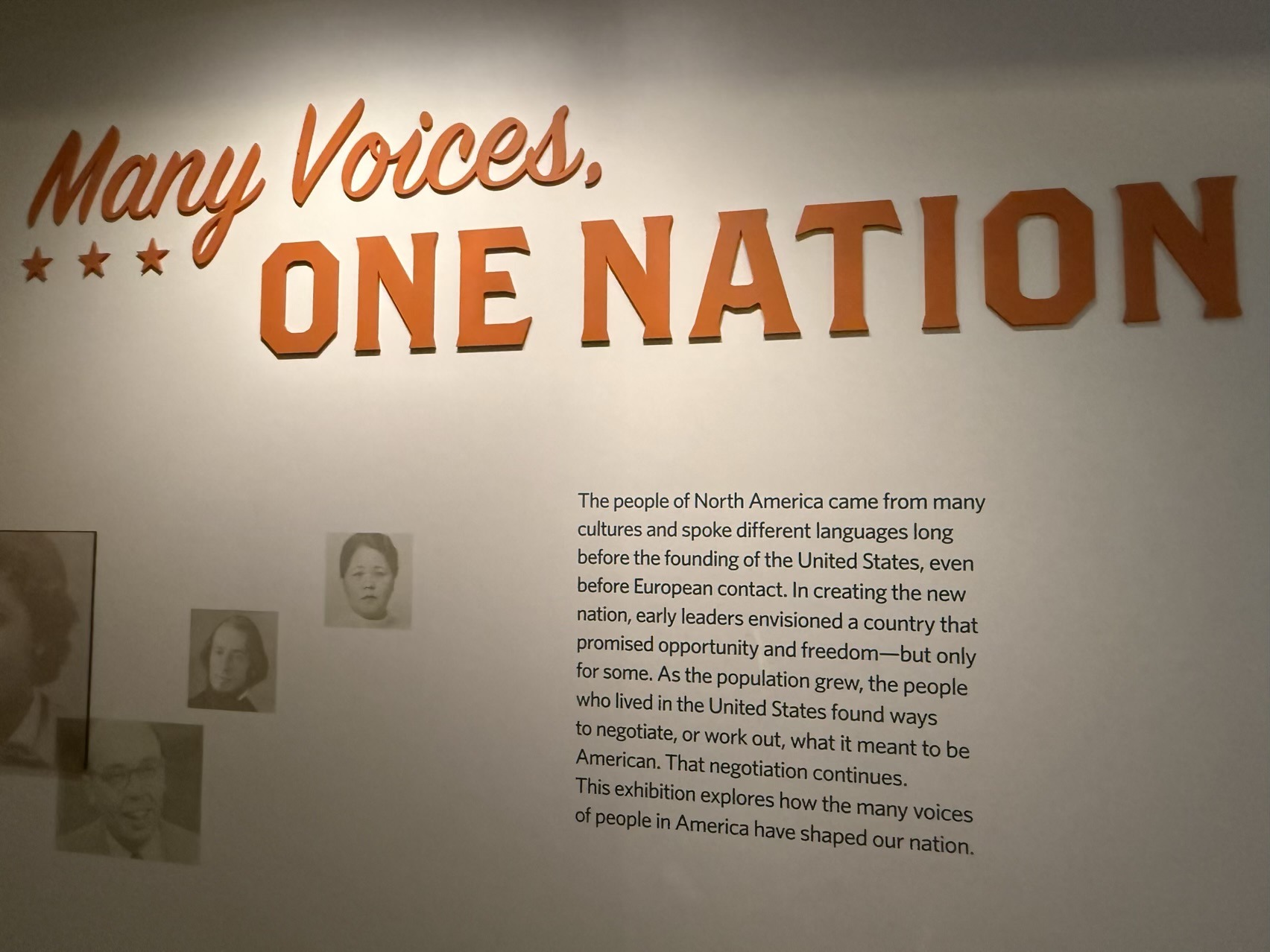
On the second floor one finds an entrance to an exhibit titled “How Did We Become Us?” It is arguably the most important question raised in the museum or in any museum in the capital because it focuses on the basis of what it means to be an American.
At the exhibit entrance, an ancient wooden carving of the statue of Liberty stands on a pedestal behind a thick layer of glass. “Some of us were already here,” reads one placard beneath it with a hand-made flint, a nod to Indigenous people whose tribes occupied the land for 1000s of years before Whites landed at Plymouth Rock. “Some of us were brought here forcibly,” reads another with a set of 1840s metal shackles, acknowledging the enslavement of over 10 million. They helped make America what it is too, although they weren’t paid for it.
Just inside the exhibit a looped recording of many voices repeats, “How did we become the United States?” A series of screens depicts photographs of people of varying cultures and creeds from around the world. As one considers this farther inside, they find varying artifacts: a broken school bus window next to a school yearbook page showing a group of African American students displayed without explanation. There’s no placard to describe its purpose and perhaps there was no placard to begin with. But it begs a question as to why there is no placard on the particular individual display. Has it been removed. If so, why? All the other parts of the exhibit have placards.
A short review of the 1954 Supreme Court decision in Brown v. the Board of Education and its striking down of the 1896 Supreme Court decision in Plessy v. Ferguson that “Separate but Equal” was the guidance for segregated schools, gives some light to that broken school bus window, the period it came to be broken, and why it is a part of the exhibit. It was a difficult part of American history that a removal of an exhibit cannot erase.
Behind another glass window there is a series of artifacts collected from the Arizona desert just North of Mexico, abandoned by desperate migrants seeking amnesty from oppressive economic or political or gang violence. A toothbrush, a shaving kit, lipstick, eyeshadow, a comb, and an empty plastic gallon jug are among these artifacts. They are part of what has made America what it is too. Millions came here without permission. They just showed up with wrinkled clothes and handbags, usually at the base of a pair of green woman’s feet. Are their histories to be revoked too?
The issue of white wash by removal is also playing out at U.S. National Parks as the newspeak policies attempt to eliminate the signage at parks across the country of the geolocations of some of the places depicted in the NMAH exhibit. A judge has ordered the signage restored but whether it has been done is unclear.
The Third Act DMV light show issues a warning at its end, “We must learn from history, especially from our mistakes.” It is evident that some here are ok with repeating the mistakes of history.
There was a late breaking report that signage would soon be posted outside the Smithsonian NMAH to warn visitors that some of the information inside was inaccurate. But the signs had not gone up as of Tuesday, July 28.
We will update this story if such signs are put up outside Smithsonian NMAH.