Washington DC—It was nine years ago on August 12, that dozens of supremacist, Alt-Right, neo-nazi, klansmen, and nationalist groups rallied in Charlottesville, Virginia against a plan to remove a statue of Confederate General Robert E. Lee from downtown Lee Park. Organized by Jason Kessler, the ‘Unite the Right’ rally was a 2-day event held 11-12 August 2017 to link far right groups into an extended extremist movement revitalizing White supremacy. The groups gained more public footing that Summer, after Trump centered nationalist figures and parroted extreme right wing talking points from his position of power. It helped create the climate and space nurturing extremism in public spaces.
Richard Spencer and his National Policy Institute, was also present at the Unite the Right rally. His far right extremist organization had already held a rally at the Press Club in downtown Washington DC the night before the 2016 inauguration. He had also held a conference at the Ronald Reagan World Trade Center and other rallies in Washington DC. Gatherings of alt-right and neo-nazis were taking place in other cities across the country.
Members of the Unite the Right groups rallied the evening of August 11 at the University of Virginia, carrying tiki-torches in the evening and chanting anti-Semitic slogans. Their cries of “Blood and soil” and “You will not replace us,” drew alarm. They were throwbacks to the Third Reich rise to power during the Weimar Republic of pre-1933 Germany. Video of a stream of men walking with torches and chanting extremist chants popped up that Friday night on social media and spread like a fire in a mattress warehouse. There were clashes between the hundreds of torch bearing extremists and counter-protesters. Mace was spayed onto counter-protesters and police declared an unlawful assembly.
Charlottesville Riot—Epoch of Incredulity
The next day, an independent media colleague requested help in covering the Saturday rally and offered to drive to Charlottesville. So we went. We parked in a public lot not more than five blocks from Robert E. Lee Park, site of the giant Lee statue scheduled to be removed.
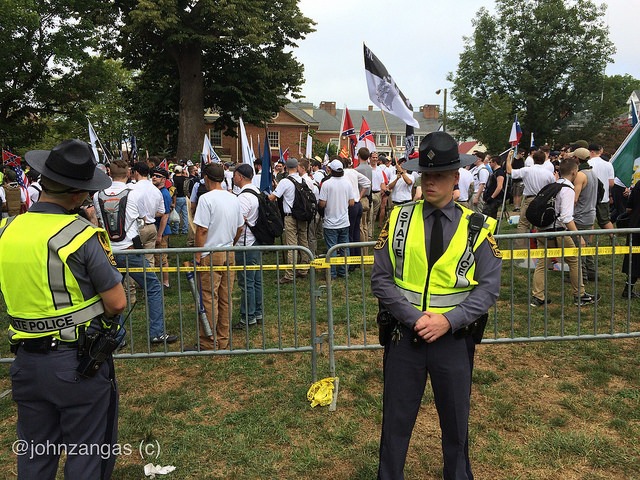
Getting close to Lee Park and the supremacist rally was straight forward. It was surprisingly easy to access. There were few Virginia State Police and only a line of short traffic metal barricades with a single strip of yellow police tape reading ‘Police Line-Do No Cross’ set up to separate the rally and counter-protesters. It seemed a considerably lax crowd control preparation. I’d covered many events in the District where right wing extremists showed up and the resultant counter-protests were never calm and orderly demonstrations. There were almost always clashes so DC police knew how to prepare for them.
So seeing such a large group of Alt-right, supremacists, and neo-nazis come together at an event with little police presence presented all the possible ingredients of incendiary civil unrest. There were fewer than a dozen police at the park. At one point there were about six police stationed at the barricades. There were several hundred extremists and as many as 500 counter-protesters. The die was cast for an historic confrontation. Police should and could have been ready, especially considering the clash from the night before. They were not prepared.
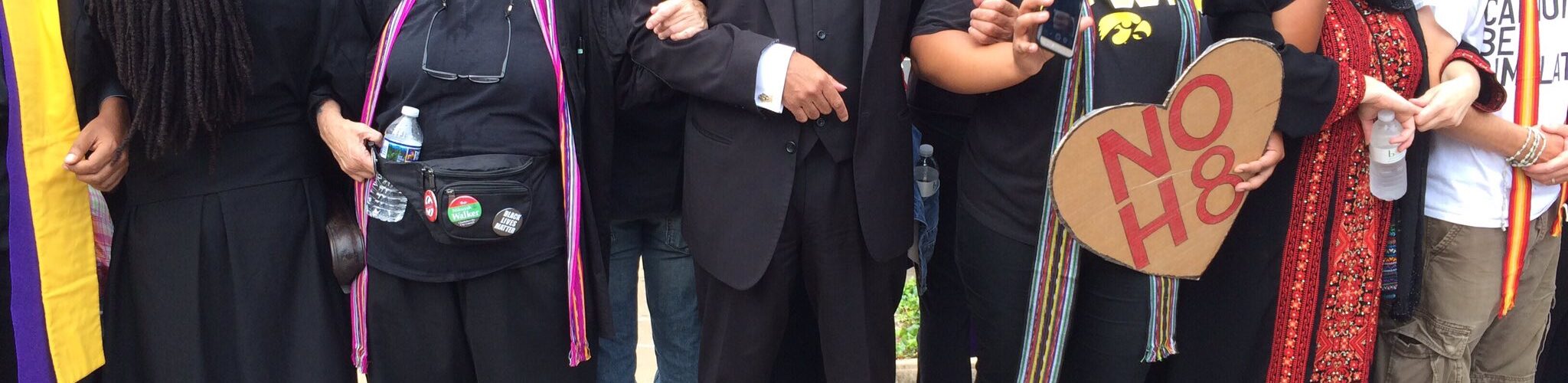
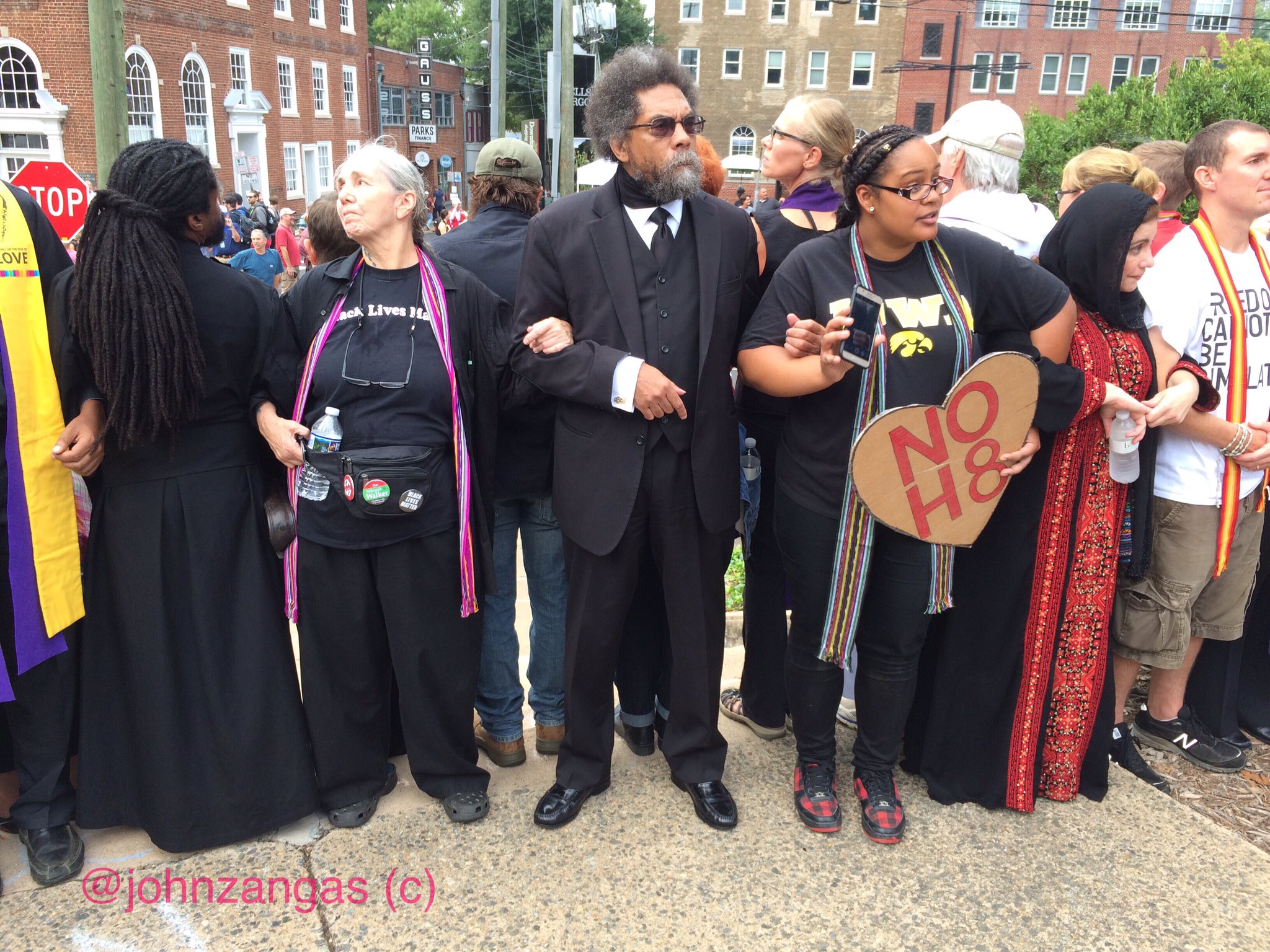
Reverend Cornel West joined hands and locked arms with dozens of fellow clergy, forming a long human wall separating the supremacists and neo-nazis from the assembled counter-protesters. When asked what his message was, he told me, “Bearing witness to love and justice.” It was the last moment of calm before the dam broke.
The rally had been scheduled to begin at 12 noon but counter-protesters had already streamed to the park oppose the extremist groups. Heckling gave way to taunting and threats. Shoving gave way to punching and assaults. The assembly was declared unlawful by 11:30 am, before it was actually scheduled to begin. Police ordered the Unite the Right rally to leave Lee park. As supremacists began leaving and walking in groups directly into counter-protesters, anti-racist counter-protesters began chanting, “ No Nazis, no KKK, no fascist USA.”
They carried signs reading ’Black Lives Matter,’ and ‘Smash Supremacy,’ amongst other hand-made signs.
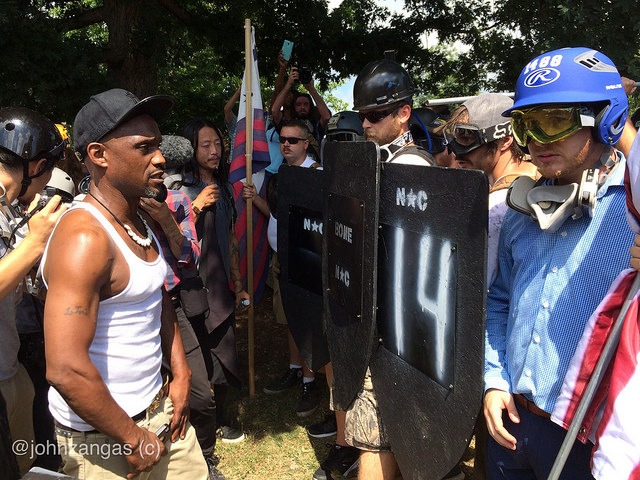
One moment of relative rationality stood out in the chaos, although there were many disturbing moments. A supremest holding a heavy shield and wearing goggles and a gas mask around his neck faced off with a sparsely dressed Black man. Tony Lewis wore only a white tank top, some slacks and a black baseball cap with a black ‘X’ over its bill.
On the shield was painted “NC 14,” a reference to the so-called “race riot” in Wilmington, North Carolina in 1898. Then, during what was actually a terrorist coup, thousands of Whites overthrew the democratically elected mixed-race government of Wilmington, burned the only African American newspaper office, burned and looted all the Black-owned businesses, and killed or lynched an estimated 3-400 Blacks. The “N.C. 14” painted on his shield was a reference to this dark day in history but the symbolism eluded many of us at that moment.
Lewis confronted the White man behind the shield after hundreds of extremists began leaving the park. Lewis tried to reason with the man, saying, I am an American too.” Lewis also told him he was a Veteran who had served in uniform during the Persian Gulf War but the man refused to hear or listen to what he had to say. The man told Lewis to “leave us alone.” It seemed that the attitude he held against Lewis mimicked the tones of 1898 Wilmington.
Moments later someone launched fireworks over the opposing groups. It was hard to tell from what side it came. Others hurled plastic bottles of water, further egging on the commotion. Then sticks and banner poles were used as clubs. Some of the supremacists carried clubs with them to the rally. They were certainly outfitted for street violence, wearing riot gear, shields, and helmets. (DCMediaGroup story from that day.)
The cordon of clergy left as the Virginia State Police declared an unlawful assembly. It was the second of such declarations they issued that weekend. What few police had been there had left the park and there were no police to stop the clashes. The opposing groups were now locked in street battles. They confronted and battled in the narrow streets and we in the media were caught in the center of the riot as factions fought for control of its center.
Sign posts became clubs and opponents beat each other. Many were injured severely. A man stomped on another who had been knocked unconscious. Several dragged him. A woman was bloodied.
As we were caught in the center, groups somehow ignored us. Someone fired a shot. It sounded like a pistol, based on previous marksmanship training. A helicopter hovered above. No police stopped or attempted to intervene to stop the fighting which had melted into the plasma of a riot. Someone threw urine and it splashed across the press line. I was thankful it wasn’t a stone. Urine can be washed away. A bloody soaked wound, not so.
We escaped through a gap in the fighting and turned east back up the hill towards the parking garage a few blocks away. We saw a group of supremacists beating a young Black man who was unconscious. We later learned his name was Deondre Harris. He was treated by street medics at the scene but needed hospitalization based on the seriousness of his wounds. We had parked feet from where he was beaten.
The worst was yet to come.
As the counter-protesters organized to march against the United the Right rally, James Fields, a white supremacist, deliberately drove his car into the assembly as it was preparing to march, killing activist Heather Heyer, and injuring 19 others, some severely.
We did not witness this but the incidents we had seen were quite enough to make every one of us sick. Several friends I knew who went to the street march were forever changed by what they saw.
During a phone interview with Jason Charter, a witness to the car attack, he said, “I heard the car screeching and I turned and see it ramming people, throwing them on the windshield and into the air,” he said. “I ran to help people and make sure they were ok and people were everywhere screaming medic.”
Charter said that moments after the car backed up, medics were on the scene helping the injured. He was shaken up by the incident. Video of Charlottesville riots (Caution Content warning—depicting violence).
Aftermath of the Charlottesville Riots
If anything could be said good about the riots it was that it re-awakened the nation to a vein of racial hatred that has existed for over two centuries. The nation clamored to denounce the groups that created havoc in Charlottesville and Jason Kessler’s ill conceived plan to unite them. His rally had the opposite effect he intended. Attitudes towards symbolic public memorials to Civil War figures changed quickly and irreversibly as citizens rallied to pressure State and local governments to remove them from public spaces and parks.
James Fields, then 20, was convicted after a federal trial and sentenced to life without the possibility of parole plus 419 years. He was subsequently tried and sentenced in Charlottesville by a State court to life imprisonment. DCMediaGroup story about the trial of James Fields.
Heather Heyer was celebrated and heralded as a civil rights beacon. She had not even planned to go to the protest but was going to meet her boyfriend for lunch nearby. She was an accidental activist that day and caught at the scene. Her mother dedicated the rest of her life to speaking out against racism in her daughter’s memory.
The blowback against Kessler was a tsunami of change. He attempted to hold a press conference the next day on 13 August in downtown Charlottesville but was run out of town by angry citizens. His speech was drowned out by angry opponents. Police had to escort him to safety.
Kessler foolishly tried a Unite the Right protest in Washington DC a year later with a march from George Washington University to the White House. About five people showed up to join him. Trackers captured his movements at the metro in Vienna. They noticed groups which had begun mobilizing weeks before in anticipation of his return. Nearly 15,000 from civil rights and human rights groups from across the region rallied in opposition to him and thousands of DC police and Federal agents formed a cordon to keep people from getting close to him. Video of Kessler and Unite the Right march in DC on August 12, 2018.
The Robert E. Lee statue was removed. The park was renamed Emancipation Park in 2017. Its name was changed again to Market Street Park in July 2018. Another Charlottesville park named after Stonewall Jackson, also a well-known Confederate General, was also renamed to Justice Park that year. Southern heritage statues came down from many cities across the South. Some were taken down by citizens with ropes and chains.
A statue of Confederate General Pike in Washington DC was taken down by citizens in 2018 after National Park Service deterred its removal. DCMediaGroup story about the Pike statue.
Richard Spencer’s National Policy Institute fell out of favor as a tide of opposition in Alexandria among citizens rose against it. The landlord renting space to his organization did not renew his lease. His website went dark in 2020.
The aftermath of the United the Right rallies saw citizens reclaiming their power over the inherent evil of supremacy by mobilizing and showing up where it reached into public forums. Rallies and protests against supremacy were held in many towns and cities across the country. This in turn carried momentum into the Black Lives Matter movement.
Video of Charlottesville Riots on August 12, 2017:
Video of anti-racism protests in DC on August 12, 2028.