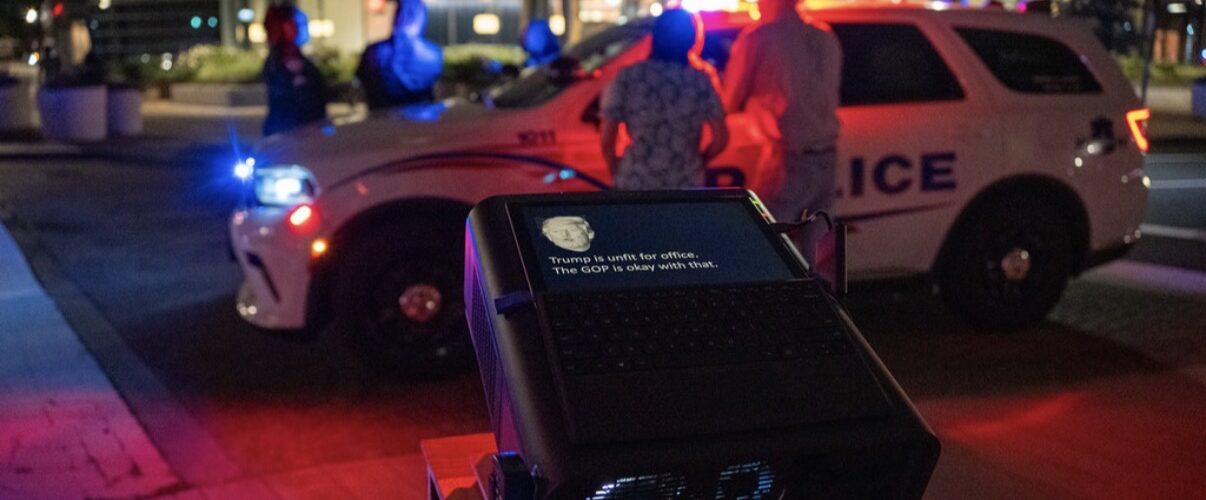
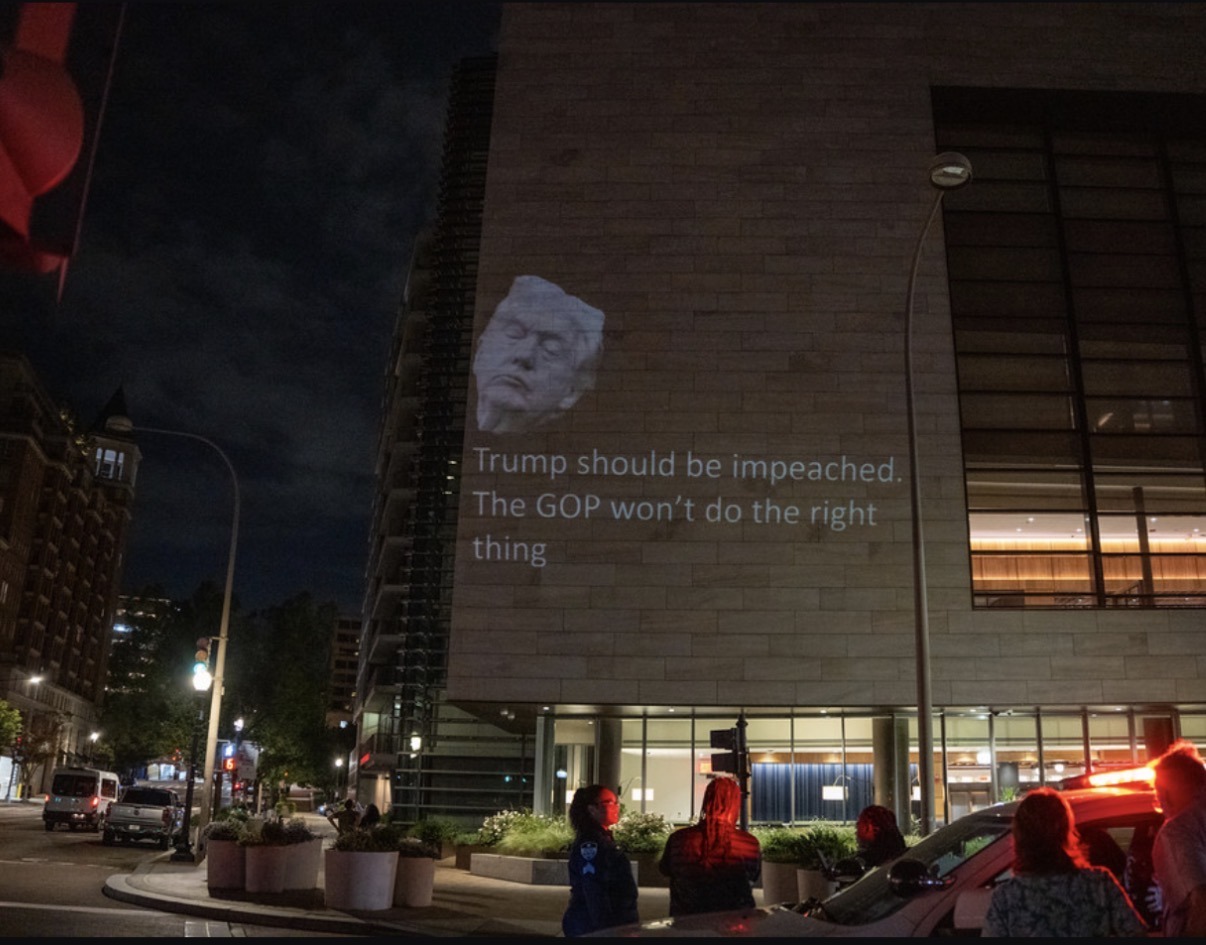
Washington DC—What was supposed to be a brief light projection onto a building turned into a lesson in First Amendment rights for DC Police on Wednesday night. While activists projected a series of slides onto the side of John Hopkins University at 5th & Pennsylvania, a security guard from the site approached them requesting they stop the projection. The activists declined the guard’s request, saying it was within their rights to project light from a public space—in this case, from the median of Pennsylvania Avenue.
At that particular median, DC police have jurisdiction. Jurisdiction in DC can be confusing and is complicated by the 47 different police agencies enforcing statutes within the District, as they have different areas of responsibility. For example, the Supreme Court is just five blocks away from the John Hopkins annex and the Supreme Court Police do not allow light projections from the street. It is a separate branch of government unto itself and therefore sets its own rules for its building.
The National Park Service (NPS) will not allow light projections onto national monuments. The NPS has jurisdiction over all the national monuments. The boundaries of the monuments are usually at the edge of the curb of the District streets, which then changes jurisdiction to District police. The streets in the boundaries of the National Mall are NPS jurisdiction.
The John Hopkins annex targeted by the projectionists is the former site of the Newseum. Washingtonians will recall it as a museum to showcase the free press and the First Amendment. The Newseum closed after financial difficulties caused losses in the millions. The beginning of the Corona Virus pandemic at the end of 2019 also sealed its fate. It sold the building to John Hopkins University which opened its graduate program there.
The security guard called DC police to intervene and stop the activists from projecting their light show. They still politely refused to go.
The light-show was a series of slides taking a jab at the Republican Party for allowing the president to break down democratic guards and promote his profit driven agenda without congressional oversight. It was in effect an indictment of those in the legislature who refuse to exercise their power under the constitution.
About an half hour later police officers arrived and asked the activists to end their show. Police cited DC code they claimed the activists were going against. The activists requested to see the code and police shared it with them from their vehicle screen. The DC code details what constitutes “defacement” of a building. It was this law that the police officer was referring to as grounds to stop the projection.
Marcos was the acting police liaison and calmly interacted with the police officer. He read back to him the DC code. He pointed out that nowhere did it mention that light projection from a public space was illegal. The light was not ‘defacing’ the building because it was not damaging the building.
Code of the District of Columbia § 22–3312.01. Defacing public or private property, reads:
“It shall be unlawful for any person or persons willfully and wantonly to disfigure, cut, chip, or cover, rub with, or otherwise place filth or excrement of any kind; to write, mark, or print obscene or indecent figures representing obscene or objects upon; to write, mark, draw, or paint, without the consent of the owner or proprietor thereof, or, in the case of public property, of the person having charge, custody, or control thereof, any word, sign, or figure.”
There is no mention of light projection in this code. Light does not technically deface a building edifice. Once it is turned off the image is gone. The officer saw that no damage was being done to the building.
Marcos was calm and deliberate in his interaction with the police officer. He stood his ground but did not raise his voice. Once the officer consulted his supervisor back at the station, he returned and apologized for getting it wrong and asked how much longer the activists would be there. It was getting late so they broke down their projector and left.
According to Marcos, some of the lessons learned included knowing the law as well as the limits of the jurisdiction. This is especially an important part of direct action in the District because there are many different jurisdictions. Remaining calm and not escalating the situation also helped the situation from becoming a long night for everyone.
In effect, having a police liaison and instructing everyone in a group to refer questions to the police liaison is a key strategy in direct actions. The liaison must be both knowledgeable on the law and a calming voice and stabilizing factor in a stressful situation. If others in the group become involved or escalate it can undermine the efforts of the police liaison.
Editor’s note: This story was amended to reflect more detail in the interaction between the police officer and the activists.